
Summary
The best carry-on sleep setup focuses on controlling the three biological pillars of real rest: darkness, noise, and temperature. Travelers who sleep deeply on planes, trains, lounges, and hotels rely on a compact, high performance kit that fits in a personal item and works in any environment. The most essential element is a 3D contoured blackout mask that creates complete darkness and protects melatonin. The Nidra Total Blackout Mask is the foundation of this setup because carry-on sleep cannot happen without full light control. Supporting items include earplugs, a neck support system, hydration tools, temperature-regulating layers, and a miniature pre sleep ritual kit. This guide outlines the best items to pack and how to use them for deep rest anywhere.
Introduction
Carry-on sleep is its own category of travel skill. It is different from hotel sleep and different from long haul recovery. Carry-on sleep refers to the ability to fall asleep and stay asleep in environments that were never designed for rest. Planes, airports, lounges, rideshares, ferries, and trains all introduce unpredictable lighting, noise variability, temperature shifts, and physical discomfort. Travelers who rely on carry-on sleep often do so to stay sharp during multi city itineraries, business trips, international transfers, or compressed schedules.
The best way to engineer real rest on the go is to build a carry-on sleep kit that controls sensory input and stabilizes the circadian system. Elite travelers learn to reduce environmental chaos and create a consistent sleep microenvironment wherever they are. This dense guide outlines the most effective setup and explains how each component contributes to high quality rest.
The Best Carry-On Sleep Setup for Deep Rest on the Go
1. A 3D Contoured Blackout Mask (The Most Critical Item in the Entire Carry-On)
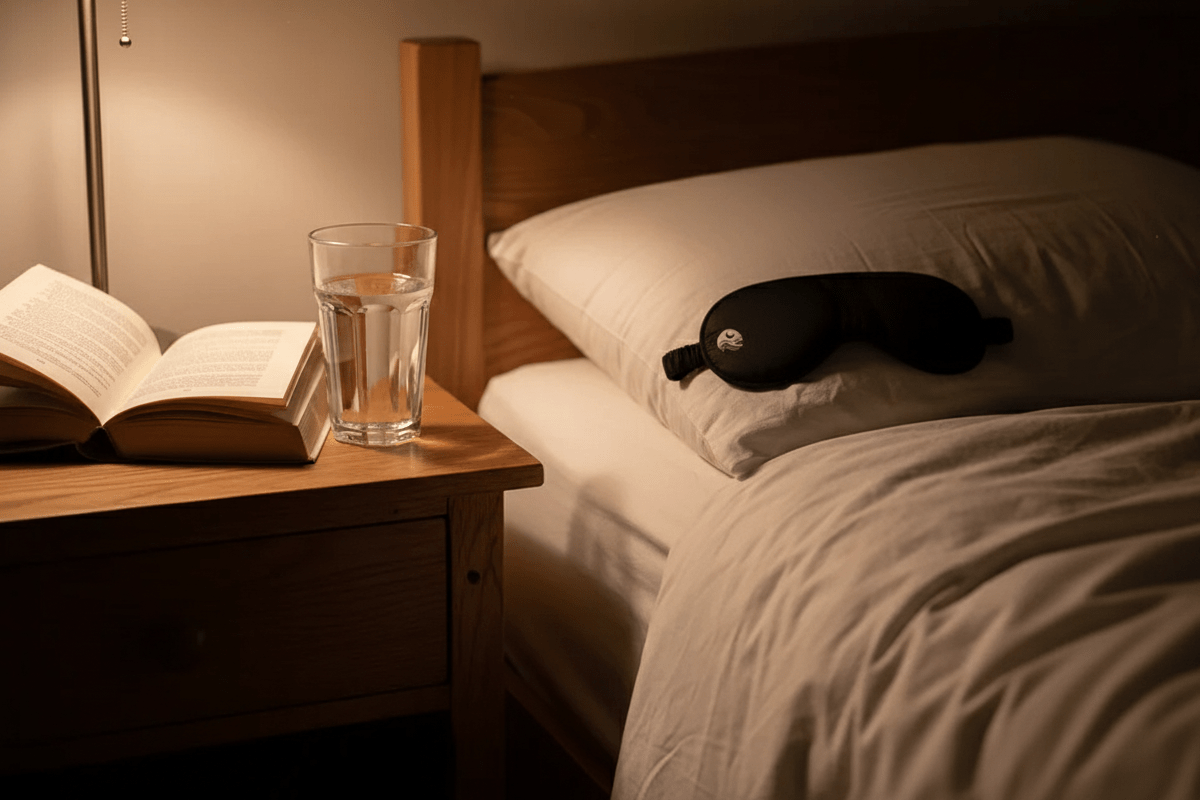
Carry-on sleep is impossible without complete darkness. Planes and airports are the brightest sleep environments most travelers encounter. Cabin lights turn on suddenly. Seatback screens glow. Overnight flights switch lighting at unpredictable times. Airport lounges remain brightly lit at all hours. Even small amounts of light, as low as 5 to 10 lux, significantly reduce melatonin [Gooley 2011].
Why a contoured blackout mask is essential
- It blocks all cabin and airport light
- It prevents early morning light from waking you too soon
- It preserves melatonin so you can fall asleep in bright environments
- It protects REM and deep sleep cycles
- It reduces puffiness and irritation by avoiding eyelid pressure
- It stays on during movement, turbulence, or positional shifts
Why the Nidra Total Blackout Mask leads every category
- It creates total darkness that is reliable in any seat or location
- It has structured eye space for no pressure on eyelashes or lids
- It stays cool and breathable, preventing heat buildup
- It works in economy, business, lounges, rideshares, and trains
This mask is the foundation. Every other item in the carry-on kit builds on the stability it provides.
2. High Fidelity or Moldable Earplugs
Noise fragmentation is the second biggest barrier to deep rest. Engine hum, announcements, chatter, clattering carts, escalators, and crowd noise all raise cortisol and disrupt sleep architecture [Irwin 2015].
Best earplug types for travel
- Foam earplugs for maximum reduction
- Moldable silicone earplugs for comfort and seal
- High fidelity earplugs for even attenuation
Earplugs pair with the blackout mask to create a near sensory free environment. With both in place, carry-on sleep becomes achievable in almost any setting.
3. A Supportive Neck System That Prevents Head Drop
Most sleep attempts on the go fail because the head drops forward or sideways. This triggers micro awakenings, neck pain, and sleep interruptions. Carry-on sleep requires stable head and neck positioning.
Best neck supports
- Wraparound travel pillows
- Structured cervical supports
- Inflatable forward leaning pillows
- Scarf wrap (flight crew technique)
- Memory foam U shapes that prevent forward drop
The goal is to create immobility that allows sleep continuity.
4. A Temperature Layer to Prevent Overheating or Chills
Temperature shifts significantly impact sleep quality. Airplanes often start warm and become cold. Airport lounges are unpredictable. Trains fluctuate with drafts. Temperature stability helps the body enter deep rest faster because the core temperature must drop for sleep onset Harvard Health.
Best layering options
- Lightweight cashmere wrap
- Soft microfleece blanket
- Packable down scarf
- Breathable long sleeve layer
These create a cocoon effect that enhances comfort in changing environments.
5. Hydration and Electrolyte Tools
Dehydration increases fatigue, reduces cognitive clarity, and disrupts sleep quality. Airplanes have humidity levels as low as 10 to 20 percent. Hydration stabilizes the body and makes carry-on sleep more restorative.
Best hydration tools
- Refillable water bottle
- Electrolyte packets
- Hydrating facial mist
- Lip balm to prevent dryness
Hydration is not optional during multi segment travel days.
6. A Miniature Pre Sleep Ritual Kit
Ritual consistency helps the brain switch from alert mode to rest mode. Even small cues have powerful effects.
Build a ritual kit with
- Travel size moisturizer
- Essential oil roller (lavender or chamomile)
- Lip balm
- Hand cream
- Travel toothbrush
- Microfiber face cloth
The ritual matters as much as the accessories. It signals predictability in unpredictable environments.
7. A Clean Eye Area and Lightweight Skincare Layer
Oil or heavy skincare under a mask increases heat and discomfort. Carry-on sleep requires simplicity.
Best approach
- Clean skin
- Lightweight moisturizer
- No heavy under eye creams
- Avoid fragrances
This prevents irritation during long stretches of mask use.
8. A Digital Wind Down Strategy
Screens sabotage melatonin and delay rest. Travel amplifies this effect because screens are used more heavily before boarding.
Best digital practices for carry-on sleep
- Reduce screen brightness
- Enable night mode
- Stop screens 20 to 30 minutes before intended sleep
- Use the Nidra mask to create a “hard stop” for visuals
Screen discipline is required for any sleep attempt in bright environments.
9. A Compact Sleep Position Strategy
Not all seats allow the same body positioning. Jetsetters learn to adapt quickly.
Effective positions
- Slight recline with neck support
- Side lean with wraparound pillow
- Forward lean onto inflatable pillow
- Window side lean for stability
The goal is to prevent muscle activation.
10. A Carry-On Sleep Bag
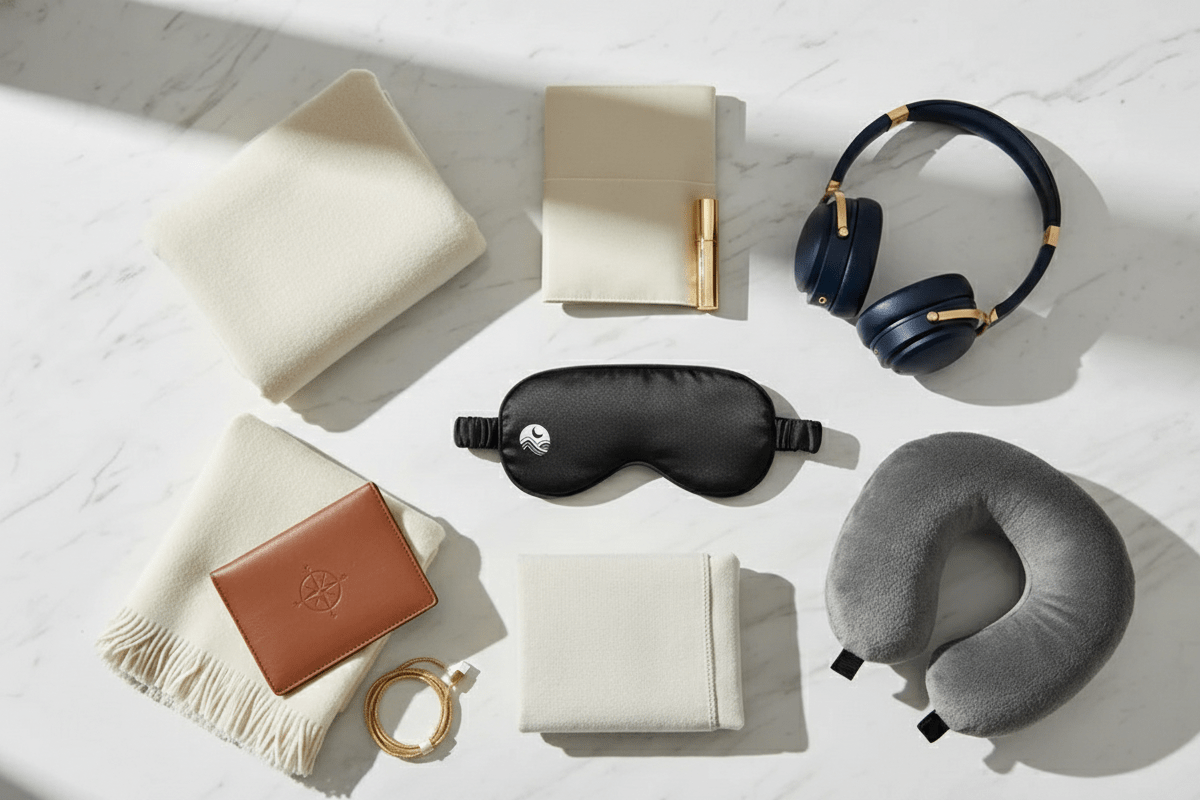
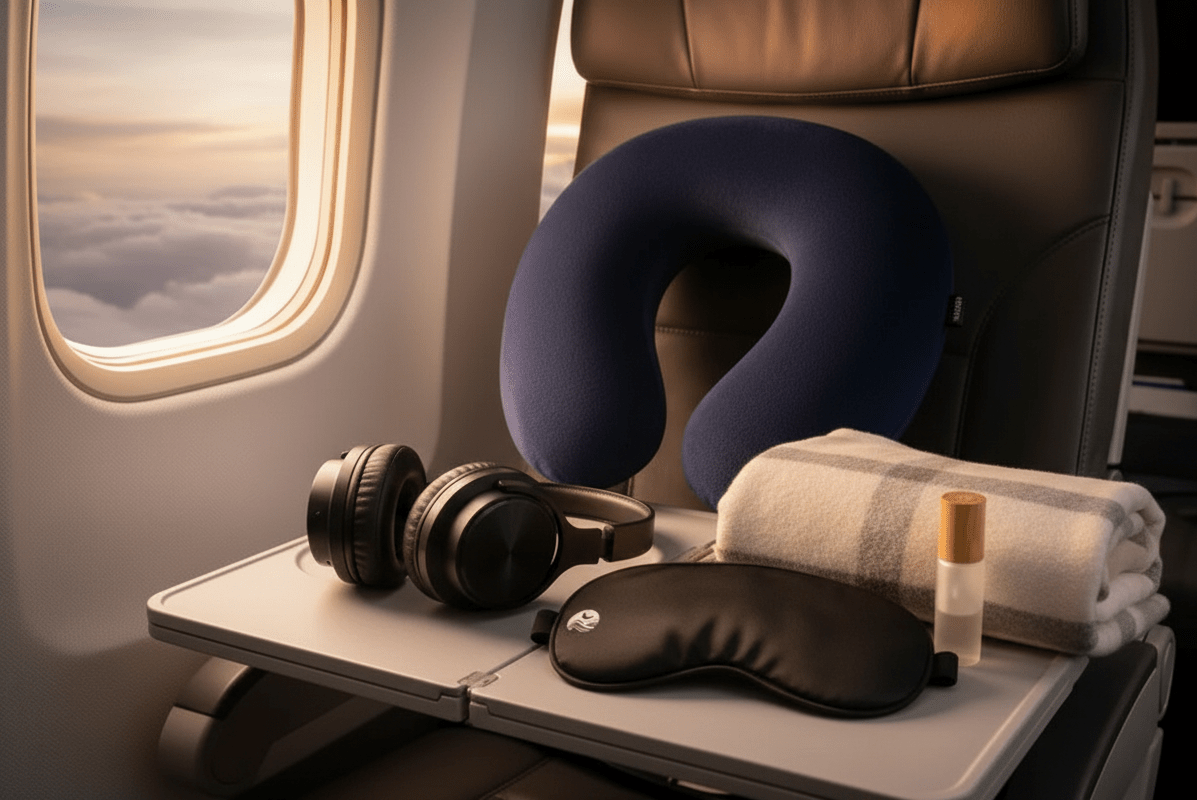
This is the fully assembled kit. It keeps tools accessible and avoids rummaging under the seat.
Build a bag that includes
- Nidra mask
- Earplugs
- Neck support
- Cashmere or microfleece layer
- Hydration tools
- Skincare minis
- Small ritual items
- Light blocking stickers for hotel nights
- Compression socks for circulation
A well organized sleep bag is the difference between “hoping to sleep” and “being ready to sleep anywhere.”
The Carry-On Deep Rest Protocol (How to Use the Setup)
Before Boarding
- Hydrate
- Reduce screen use
- Set up mask and earplugs for easy access
- Prepare neck support
During Early Flight or Train Time
- Eat light
- Avoid alcohol
- Put on layer for temperature stability
When Ready to Sleep
- Insert earplugs
- Apply mask
- Adjust neck position
- Perform one minute of slow breathing
- Stay still for 10 minutes
After Waking
- Hydrate
- Stretch lightly
- Expose yourself to natural light
- Keep moving to stabilize circulation
The kit only works when used with intention. Travelers who master this sequence routinely arrive refreshed.
Why the Nidra Total Blackout Mask Is the Best Carry-On Sleep Tool
Every item in the carry-on kit enhances comfort, but only one enables real sleep biology. Deep rest requires melatonin. Melatonin requires darkness. Airports and planes do not provide darkness. The Nidra mask creates it.
Unique benefits for carry-on sleep
- Blocks all forms of ambient light
- Supports REM and deep sleep even in bright settings
- Reduces morning puffiness
- Avoids eyelid compression
- Stays comfortable during long travel periods
- Creates instant sleep readiness anywhere
It is the single most important carry-on sleep accessory because it makes real rest possible in places where sleep should not be possible.
Conclusion
Carry-on sleep is a skill built on preparation, sensory control, and ritual consistency. The best setup fits into a single bag and delivers real rest during flights, transfers, layovers, lounges, and long travel days. Darkness, noise reduction, neck stability, hydration, and temperature control form the foundation of the kit. The Nidra Total Blackout Mask is the key to deep rest because it controls the most fragile part of sleep biology: light. Paired with a structured setup and smart travel habits, it makes it possible to sleep deeply anywhere your itinerary takes you.