
Summary
Rushing to bed rarely produces rest. The human brain needs a predictable wind-down period to shift from alert mode to recovery mode. A deliberate, repeatable nighttime ritual lowers stress hormones, synchronizes the body clock, and strengthens sleep quality over time. This article shows how to design that ritual around light, temperature, mindset, and environment—without adding complexity. The Nidra Total Blackout Mask serves as the final cue that it’s time to switch off completely.
Introduction
You finish emails, check one more message, and collapse into bed—only to lie awake with your mind racing. Sound familiar?
Modern life runs on urgency; sleep doesn’t. The transition from work to rest requires intention.
Think of your nighttime routine as pre-sleep conditioning: a sequence that signals to the body and mind that activity is ending. Executives and founders who treat this as part of their performance strategy—not indulgence—report sharper focus, steadier moods, and fewer late-night spirals.
This guide distills evidence-based practices into a practical, 20- to 30-minute ritual that anyone can implement.
Why Rituals Work: The Science of Habit and Physiology
Habits reduce decision fatigue. When a behavior becomes automatic, willpower isn’t required. Repeating the same sequence before bed helps your nervous system anticipate sleep.
- Cortisol decline: Evening relaxation behaviors lower cortisol, which otherwise delays sleep onset Harvard Health 2025.
- Melatonin rise: Dim light and darkness increase melatonin, signaling biological night Gooley 2011.
- Parasympathetic activation: Slow breathing, journaling, or stretching increase heart-rate variability, shifting the body into rest-and-digest mode Front Physiol 2022.
In short, rituals create predictability. Predictability tells the brain it’s safe to let go.
Step 1: Define a Consistent Lights-Out Target
Sleep research consistently finds that regular timing is more important than perfect duration for circadian alignment Harvard Health 2025. Pick a bedtime window—say, 10:30–11 p.m.—and protect it like an appointment.
Consistency stabilizes the circadian rhythm, which in turn optimizes hormone timing, metabolism, and mood regulation. Even on weekends, keep deviations under an hour.
Step 2: Manage Light Like a Nutrient
Light is the strongest environmental cue for your body clock. Control its “dose.”
Two hours before bed:
- Dim overhead lighting and switch to warmer color temperatures.
- Activate night-shift or blue-light-filter modes on all devices.
- Replace bright vanity bulbs with low-lux ambient lighting.
At lights-out:
- Block all residual illumination—alarm LEDs, hallway glow, partner reading lamps.
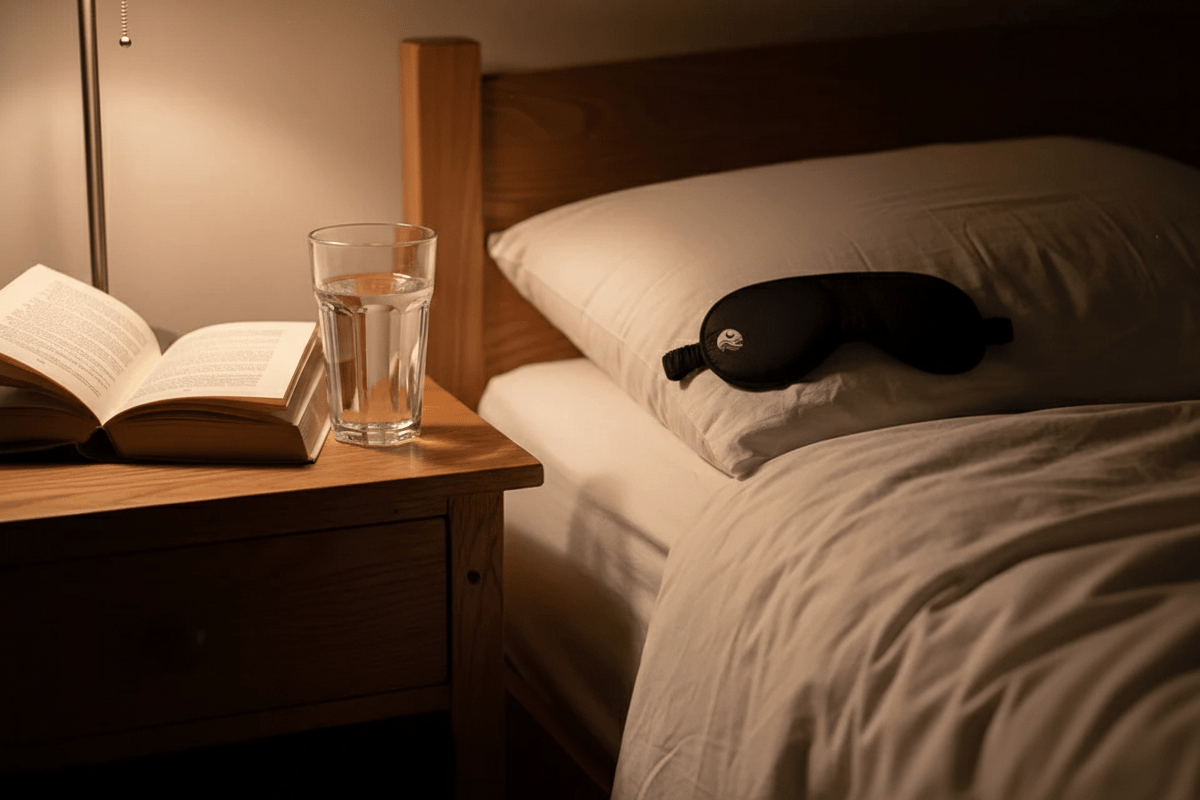
- Wear a contoured blackout mask such as the Nidra Total Blackout Mask, which seals side leaks while keeping fabric off lashes and lids.
True darkness allows melatonin to rise smoothly and keeps REM cycles intact through the night Harvard Health Blue Light 2024.
Step 3: Add a Mental Off-Ramp
Your mind can’t go from 120 emails per hour to zero. It needs a buffer. Pick one technique and stick with it:
- Breathing reset: Inhale 4 seconds, exhale 6 seconds, repeat 10 times. This ratio lowers heart rate and triggers calm Front Physiol 2022.
- Pen-and-paper dump: Write tomorrow’s top three tasks. Putting them on paper clears mental space.
- Gratitude note: Jot one win or moment of appreciation. Small, positive reflection reframes stress.
- Gentle stretch: Five minutes of neck rolls or child’s pose improves circulation and relieves tension.
Consistency matters more than variety. Perform the same “off-ramp” each night so the body recognizes it as a cue.
Step 4: Optimize Temperature and Sensory Inputs
Core body temperature naturally drops before sleep. Facilitate it:
- Keep the bedroom around 65 °F / 18 °C.
- Take a warm shower 60 minutes before bed—heat triggers vasodilation followed by cooling.
- Choose breathable fabrics for bedding and sleepwear.
Noise and scent also play roles. White-noise apps or soft music mask disruptions; subtle lavender or sandalwood scents correlate with increased relaxation scores in small trials Sleep Med Rev 2023.
Step 5: Layer in Behavioral Anchors
Rituals work best when anchored to existing habits. Example:
- Brush teeth → apply skincare → dim lights → breathing practice → mask on.
Layering to a fixed sequence reduces cognitive load. Within two weeks, the ritual runs automatically—your body starts releasing melatonin as soon as you begin.
The 20-Minute Ritual Blueprint
| Time | Action | Purpose |
|---|---|---|
| T-20 min | Dim lights, end screen use | Signal dusk to circadian system |
| T-15 min | Warm shower or facial cleanse | Trigger body-cooling cascade |
| T-10 min | Write, stretch, or breathe | Lower cognitive load |
| T-5 min | Apply skincare | Support barrier recovery |
| T-0 min | Mask on, lights out | Reinforce full darkness cue |
Repeat nightly. Simplicity wins.
The Role of Darkness in the Ritual
Darkness is not absence—it’s instruction. When eyelids sense light, even closed, the brain interprets “day.” When darkness persists, melatonin remains high, and restorative stages—slow-wave and REM—consolidate Harvard Health REM 2024.
The Nidra Total Blackout Mask provides portable darkness with contoured depth to protect lashes and minimize pressure. Using it at the end of your ritual becomes the final behavioral anchor: mask = sleep.
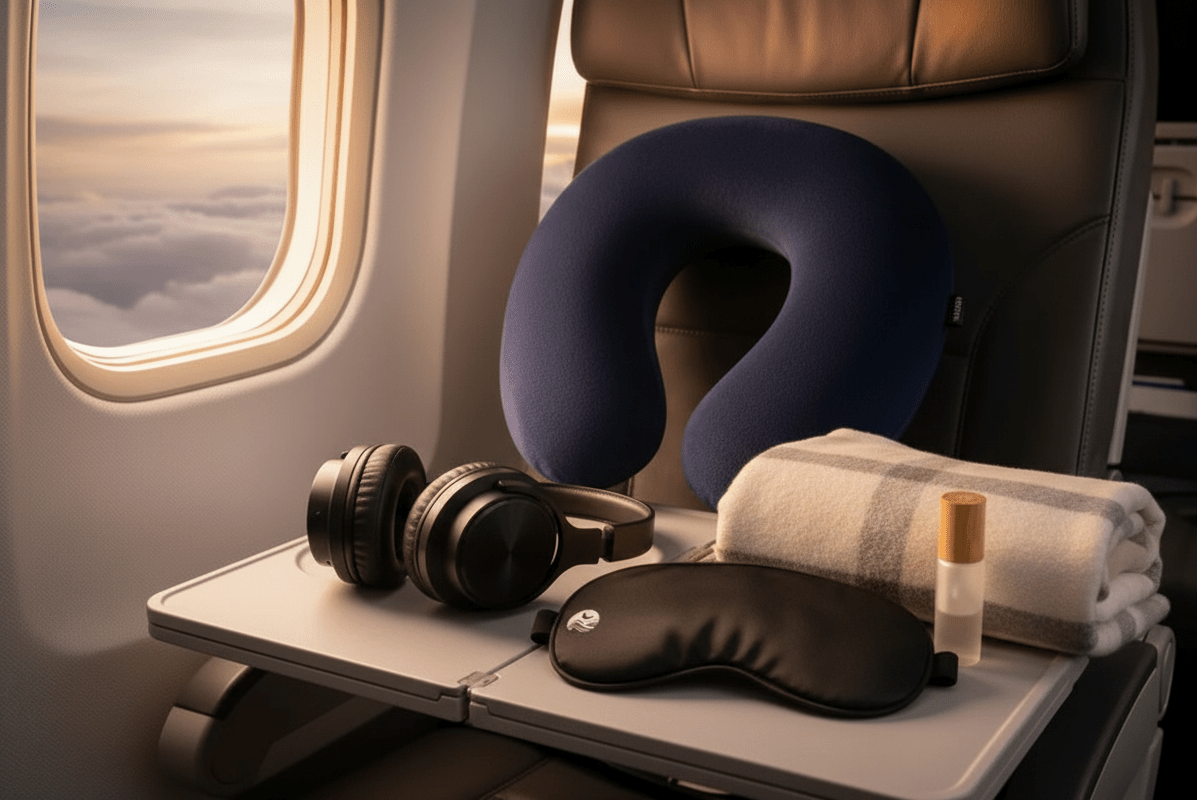
For travelers, that cue consistency is invaluable; the brain associates the mask with rest regardless of time zone or environment.
Step 6: Audit and Iterate
Track outcomes for two weeks:
- Sleep latency: minutes it takes to fall asleep.
- Awakenings per night.
- Morning mood: one-word check-in (calm, groggy, focused).
Improvement of even 15 percent across these metrics means your ritual is working.
If not, refine one variable at a time—earlier wind-down, darker environment, cooler room.
Common Mistakes and Fixes
| Mistake | Why It Matters | Quick Fix |
|---|---|---|
| Scrolling until lights-out | Blue light delays melatonin | Phone curfew 60 min before bed |
| Bright skincare mirrors | Contradicts darkness signal | Use dim warm light |
| Ignoring travel adjustments | Different light cues confuse clock | Carry mask; follow jet-lag light plan |
| Inconsistent bedtime | Disrupts circadian stability | Fixed window ± 30 min |
Measuring ROI for Professionals
Sleep rituals improve more than rest—they enhance next-day performance.
- Faster decision-making and fewer emotional dips after stressful meetings.
- Improved complexion through lower cortisol and inflammation Harvard Health Beauty Sleep 2024.
- Higher energy consistency for presentations and workouts.
Treat rest as infrastructure: it sustains every output that defines success.
Conclusion / Key Takeaways
Building a nighttime ritual is not about candles or complexity—it’s about creating conditions for your biology to relax on cue.
- Keep timing consistent.
- Reduce light and screen exposure gradually.
- Add a simple cognitive off-ramp.
- Maintain cool, quiet, dark conditions.
- End with a clear signal—mask on, world off.
Citations
- Sleep Hygiene: Simple Practices for Better Rest
- Exposure to Room Light Before Bedtime Suppresses Melatonin
- Frontiers in Physiology: Slow Breathing and Autonomic Balance
- Blue Light Has a Dark Side
- REM Sleep: Why It Matters
- Sleep Foundation: Exercise and Sleep
- Beauty Sleep Is Real: Harvard Health 2024