
Summary
Jet lag happens when your body clock and destination time are misaligned. The fix is not only sleep — it’s timed light and darkness. Strategic exposure to morning light, disciplined evening darkness, hydration, and consistent cues help you reset faster. For high-performing women who travel for work, a blackout mask like the Nidra Total Blackout Mask becomes a non-negotiable tool: it enforces darkness on planes, in bright hotels, and during early-morning sunrises so you can stay focused, composed, and radiant on the road.
Introduction
You step off a six-hour red-eye, slide straight into a client meeting, and feel like your brain is half a day behind. Jet lag is more than fatigue — it’s circadian misalignment. For professionals whose schedules cross time zones regularly, unmanaged jet lag erodes decision quality, mood stability, and even skin clarity.
Most advice focuses on caffeine or melatonin. What matters more is light control: when to seek it and when to block it completely. This article unpacks the physiology, then turns it into a precise travel protocol that keeps you sharp, calm, and camera-ready anywhere in the world.
Understanding Jet Lag: The Science of Disruption
Your circadian rhythm is an internal 24-hour clock synchronized primarily by light exposure. The eyes send light information to the suprachiasmatic nucleus (SCN), which coordinates hormonal and metabolic timing. Crossing multiple time zones forces the SCN to recalibrate — a process that can take days.
- Eastward travel (New York → London) shortens the day. You must advance your body clock, which usually adapts more slowly.
- Westward travel (London → New York) lengthens the day. You must delay your clock, which most people handle better.
Research shows symptoms peak when internal and local time differ by three to five hours: fragmented sleep, impaired alertness, GI upset, and lower reaction time CDC Yellow Book 2025.
Melatonin is the biochemical messenger of night. When light hits the retina at the wrong local time — for instance, bright airport lighting at 11 p.m. destination time — melatonin release is suppressed, pushing sleep later Harvard Health, Blue Light 2024.
Why Darkness Is the Secret Weapon
Light drives adaptation; darkness allows it to take hold. Studies confirm that carefully timed darkness shortens jet-lag recovery when combined with appropriate light exposure Sleep Foundation 2025.
Even moderate illumination can sabotage melatonin’s rise Gooley 2011. On planes and in hotel rooms, total blackout is rarely possible without help. That’s why experienced travelers carry their own darkness: a contoured blackout mask.
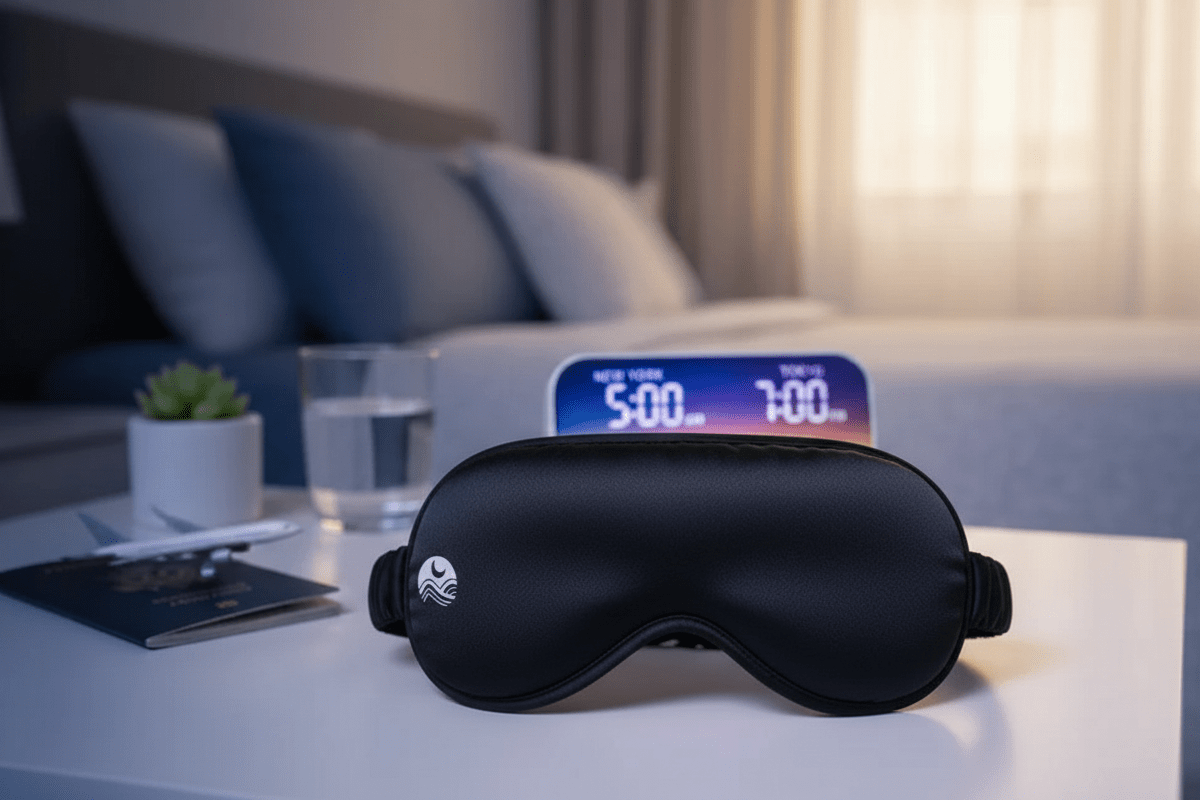
A high-quality mask such as the Nidra Total Blackout Mask fully seals ambient light while keeping pressure off the eyes and lashes — critical when you’re catching sleep upright or under harsh cabin LEDs.
A Practical Reset Framework for the Professional Traveler
- Time Your Light Exposure
| Direction | When to Seek Light | When to Block Light | Notes |
|---|---|---|---|
| Eastbound (advance) | Early-morning local light | Late evening pre-arrival | Start advancing bedtime 2-3 days before flight. |
| Westbound (delay) | Late-afternoon local light | Early-morning sun | Push bedtime later for two nights before flight. |
Plan light like medicine. If you arrive in Paris at 7 a.m., get sunlight exposure immediately; if you land in Tokyo at 8 p.m., block light until morning.
-
Build a Flight Routine
- Pre-flight: Hydrate; caffeine cutoff 6 h before planned sleep.
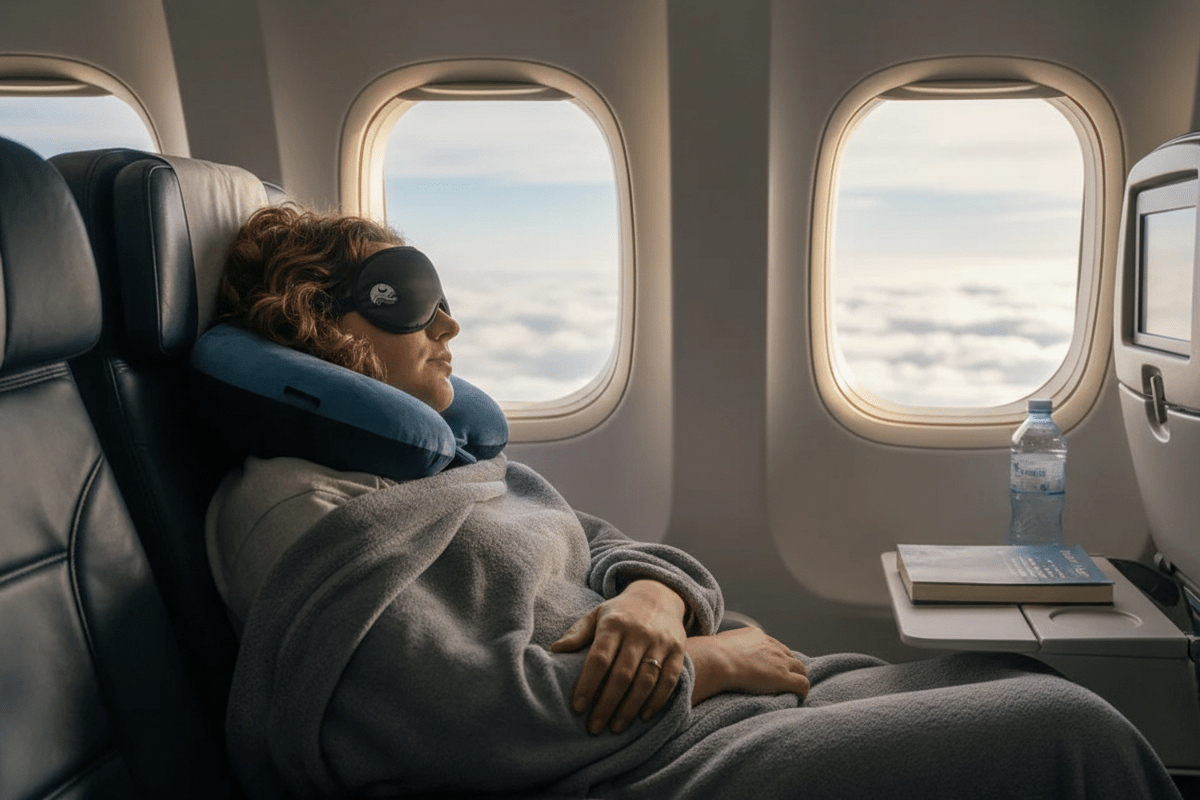
- On board: Eat lightly, skip alcohol, and use your Nidra mask + earplugs when ready to sleep. Cabin lighting follows airline schedules, not circadian logic — block it out.
- Set your watch to destination time at boarding. Begin adjusting behavior immediately.
-
Anchor with Darkness at Destination
Your first nights set the tone. Dim room lighting two hours before target bedtime. If the hotel offers no blackout curtains (many don’t), use your mask to enforce darkness until your body catches up.
Morning outdoor light is equally crucial. Harvard Health experts emphasize that 15–30 minutes of daylight soon after waking speeds adaptation and boosts mood Harvard Health, Sleep Hygiene 2025. -
Supportive Habits
- Meal timing: Eat on destination schedule within 12 hours of arrival; it cues metabolic clocks.
- Movement: Light exercise outdoors strengthens circadian realignment Sleep Foundation 2025.
- Hydration: Cabin air dries mucous membranes and increases fatigue perception. Two cups water per flight hour is a good baseline.
- Caffeine strategy: Use it only during destination daytime, never after 2 p.m. local time.
-
Optional Melatonin Use
For some travelers, low-dose melatonin (0.5–3 mg) taken at local bedtime helps advance or delay the clock, but timing is key. Public-health guidelines warn that mistimed supplementation can worsen jet lag CDC Yellow Book 2025. Darkness via a sleep mask remains the safer, behavioral first line.
The Performance and Beauty Angle
Jet lag affects cognition and complexion alike. Research links sleep loss to elevated cortisol and increased skin inflammation, which dulls tone and delays healing Harvard Health, Sleep and Skin 2024. For executives who must look and think fresh after long flights, darkness is skincare.
In practice:
- Sleeping in complete darkness reduces night-time micro-arousals that cause under-eye puffiness.
- Using a contoured mask prevents fabric friction that could disturb makeup or lash extensions between meetings.
- Consistent rest across time zones protects emotional composure — essential for negotiations and presentations.
Case Example: The Week-Long London–Singapore Loop
- Day 0 (New York): advance bedtime by one hour; avoid late-night laptop glare.
- Day 1 (flight): eat dinner early, mask on after meal service, sleep through mid-flight.
- Day 2 (arrival morning): sunlight exposure; short 20-minute walk.
- Day 3–4 (Singapore): maintain consistent lights-out using mask; caffeine only before noon.
- Day 5 (return west): delay bedtime; use mask to sleep past early dawn at home.
Following this schedule, internal and external time realign within three days rather than the usual five to six.
Executive Travel Recovery Checklist
Before You Fly
- Adjust sleep schedule 2 nights prior (± 1 h).
- Pack: Nidra Total Blackout Mask, earplugs, refillable bottle, magnesium tablets, protein bar.
- Choose aisle or window seat based on when you plan to sleep (window for eastbound overnight).
In Flight
- Hydrate every hour.
- Set devices to destination time.
- Mask + earplugs after meal service; skip inflight movie.
Upon Landing
- 15–30 min outdoor light exposure.
- Keep caffeine for local morning only.
- Short nap (< 30 min) if necessary — always with mask to ensure quality.
During Stay
- Maintain same bedtime ± 30 min.
- Dim lights two hours before bed.
- Use Nidra mask nightly to block city or hallway light leaks.
Conclusion / Key Takeaways
Jet lag isn’t a badge of productivity; it’s a performance drag. Professionals who treat light like a nutrient — dosing it by timing, spectrum, and duration — recover faster and operate clearer. Darkness is half that equation. A true blackout mask enforces darkness anywhere, turning chaos into consistency.
With a Nidra Total Blackout Mask, you carry your own night across time zones: light control on a plane, in a hotel, or even under early-rising city sun. Pair that with strategic morning light, hydration, and stable meal timing, and your body keeps pace with your ambitions.
Nidra Brand Perspective
The Total Blackout Mask was engineered for professionals whose energy and clarity depend on restorative sleep — wherever they are in the world. By giving you portable darkness, Nidra helps you reset faster, think sharper, and feel fully present, from boardroom to boarding gate.