

Summary
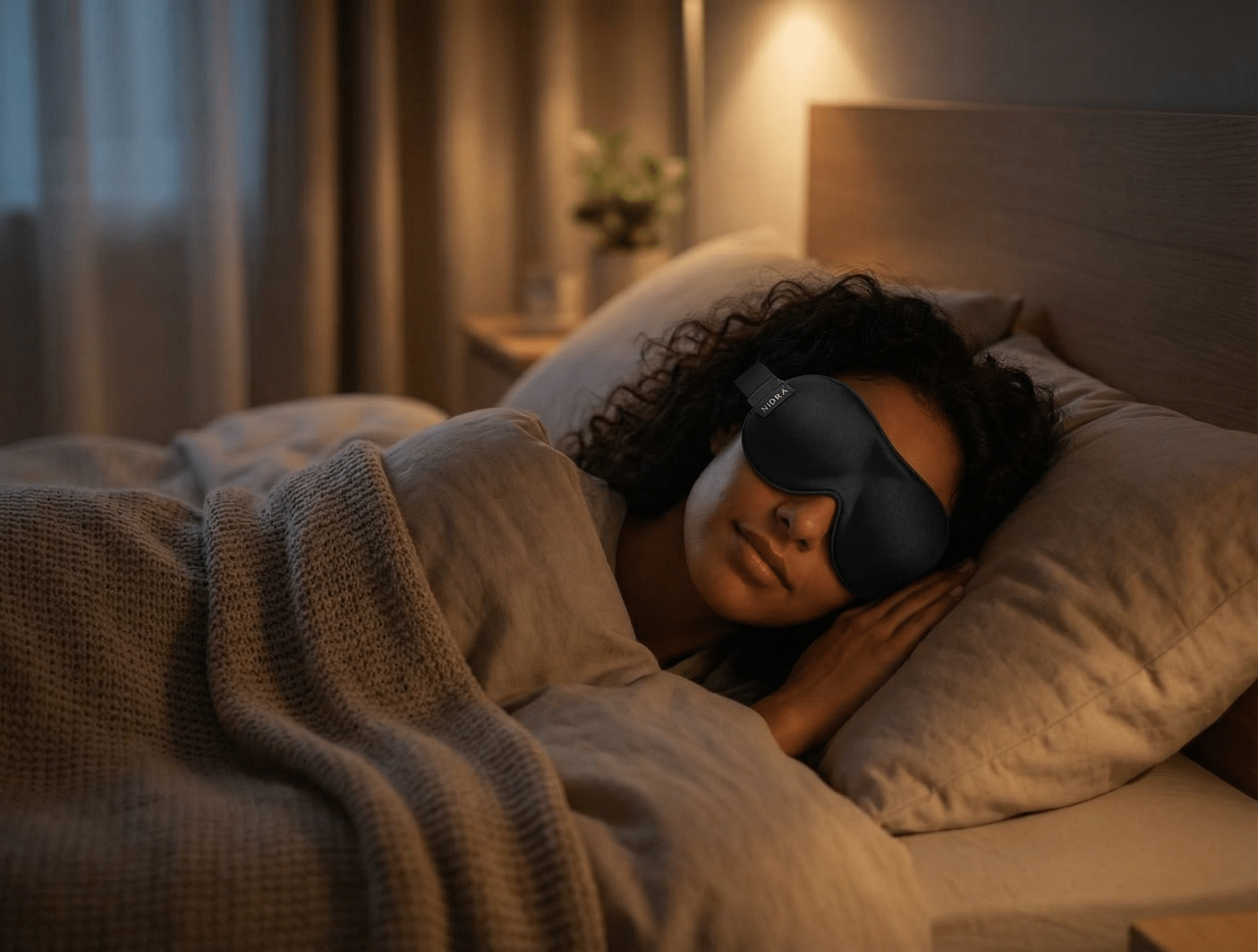
Darkness is a neurological signal—not just an environmental condition. When the brain detects darkness, melatonin rises, cortisol declines, and the prefrontal cortex shifts out of analytical mode. This transition enables deep sleep and stable REM cycles, which directly support mental clarity, memory, emotional regulation, and productivity. Even dim light at night suppresses melatonin and fragments sleep architecture, leading to slower thinking, decreased problem-solving ability, and reduced focus the next day. Creating consistent darkness with a structured blackout mask—such as the Nidra Total Blackout Mask—preserves sleep depth and unlocks sharper daytime cognition.
Introduction
Productivity and mental clarity are often framed as daytime skills: discipline, time-blocking, organization, focus techniques. But these daytime behaviors depend heavily on what happens at night.
Your brain's ability to think clearly, regulate emotions, absorb information, and make decisions is determined by how effectively it recovers while you sleep.
And the most important environmental factor affecting sleep quality is darkness.
Modern life makes true darkness rare. Apartment lighting, street glow, electronics, hallway LEDs, and early-morning sunrises disrupt the brain's nighttime processes. Light suppresses melatonin, fragments REM, and increases nighttime awakenings—all of which erode cognitive performance.
This explainer reveals how sleeping in complete darkness enhances mental clarity, stabilizes mood, strengthens memory, and improves productivity. It also explains why Nidra-style total blackout is uniquely effective at delivering the level of darkness the brain needs.
Why Darkness Matters for Cognitive Performance
Darkness Triggers Nightmode Physiology
The brain uses light to determine if it should be alert or restorative.
In darkness, two important things happen:
● Melatonin rises, signaling the brain to shift into nighttime repair
● Arousal centers deactivate, reducing sensory processing and cognitive load
These two changes enable the brain to enter deep, stable sleep.
Even dim light interferes with this. Light as low as 5–10 lux (streetlight through curtains) reduces melatonin and increases wakefulness during sleep [Gooley 2011].
When melatonin is suppressed:
● You take longer to fall asleep
● You wake more throughout the night
● Deep sleep is shortened
● REM becomes fragmented
These are the ingredients of foggy mornings and low productivity.
How Darkness Supports Deep Sleep (The Stage Responsible for Physical and Mental Reset)
Deep sleep, or slow-wave sleep, handles the heavy lifting of brain recovery.
What deep sleep does:
● Replenishes cellular energy
● Repairs neurons
● Stabilizes blood sugar
● Strengthens the immune system
● Clears waste through the glymphatic system
● Resets synaptic signaling
The glymphatic system is particularly important for mental clarity.
It removes toxic metabolic byproducts—including amyloid-beta—that accumulate during waking hours.
This clearance happens mostly during deep sleep.
How darkness improves deep sleep
Darkness increases melatonin stability, which improves slow-wave intensity and continuity.
Light causes micro-arousals that interrupt deep sleep cycles, reducing how restorative they are.
Poor deep sleep leads to:
● Brain fog
● Lowered motivation
● Physical fatigue
● Slower processing speed
● Reduced learning capacity
Deep sleep thrives in darkness. Even small disruptions matter.
How Darkness Protects REM Sleep (The Stage Responsible for Mental Clarity, Memory, and Productivity)
REM sleep is where the brain performs its high-level maintenance tasks.
What REM does:
● Integrates new knowledge
● Consolidates memory
● Resets emotional circuits
● Enhances creativity
● Improves problem-solving
● Regulates attention
REM is extremely sensitive to light.
Exposure to light during sleep—even very dim light—reduces REM percentage and increases fragmentation [Harvard REM 2024].
When REM is disrupted:
● You overreact emotionally
● You have trouble concentrating
● You make poorer decisions
● You recall less of what you learned
● You experience more stress throughout the day
Stable REM requires consistent darkness.
How Darkness Enhances Cognitive Performance
1. Faster Thinking
Enhancing sleep depth and REM directly improves:
● Working memory
● Reaction time
● Processing speed
● Verbal fluency
When sleep fragmentation decreases, neural networks fire more efficiently.
2. Better Focus and Reduced Distractibility
Darkness improves sleep continuity.
Continuous sleep supports the prefrontal cortex—the region responsible for:
● Focus
● Logical reasoning
● Executive function
Poor darkness = fragmented sleep = fragmented attention.
3. Improved Memory and Learning
REM and deep sleep consolidate memory.
Without consistent darkness, both stages are shortened.
People who sleep in bright rooms perform worse on memory tasks the next day.
4. Higher Emotional Stability
REM recalibrates emotional responses.
Without uninterrupted darkness, you process emotions less effectively.
This leads to:
● Irritability
● Stress sensitivity
● Overreactions
● Lower resilience
Darkness protects the emotional reset that supports calm, productive days.
5. More Morning Energy
True darkness supports melatonin rhythms that improve morning cortisol timing.
This results in:
● Easier waking
● Less grogginess
● Better motivation
● Clearer thinking upon rising
Morning clarity depends on nighttime darkness.
Why Total Blackout Outperforms "Mostly Dark"
Most people believe that dimming lights is enough.
It isn't.
The brain's receptor cells detect even small amounts of light through closed lids.
Common nocturnal light sources:
● Street lamps
● Headlights
● Apartment hallway lights
● Smart device LEDs
● Chargers
● Router lights
● Alarm clocks
● Digital thermostats
● Neighbors’ window glow
Studies show these light levels fragment sleep and reduce REM [Harvard Health 2025].
Total blackout is the only reliable state for optimal cognitive recovery.
Why Nidra-Style Total Blackout Is Better Than Room Blackout
Room blackout solutions (curtains, films, blinds) help, but they are incomplete.
Limitations of room-based blackout:
● Curtains leak at edges
● Light enters under doors
● Hotels are inconsistent
● Streetlights bypass curtain rods
● Morning sun breaks through gaps
● Travel environments rarely allow room blackout
Nidra-style total blackout solves the root problem
Instead of trying to darken the entire room, a Nidra-style mask eliminates light at the sensory input point: the eyes.
This is more effective because cognitive recovery depends on retinal darkness, not room darkness.
What Makes Nidra-Style Total Blackout Ideal for Mental Clarity and Productivity
1. True Zero-Light Seal
The structured foam design molds around the face, blocking the common leak points at:
● Nose bridge
● Cheek contour
● Outer eye region
Most masks fail here—Nidra does not.
2. 3D Contoured Eye Cups
Eye cups create lash clearance and protect natural REM eye movement.
Flat masks interfere with REM by pressing on eyelids.
3. Zero Pressure on the Eyes
Pressure on the eyelids reduces comfort and triggers micro-arousals.
Nidra's design rests on facial bone structure instead.
4. Stable During Movement
Side sleepers often lose blackout with standard masks.
Nidra maintains its seal through movement and shifts in position.
5. Effective Anywhere
Whether you are in:
● A bright apartment
● A hotel
● A flight cabin
● A room with early sun
● A shared sleeping environment
A Nidra-style mask ensures consistent darkness.
This portability is crucial for professionals who need consistent morning performance no matter where they sleep.
Step-by-Step Protocol for Boosting Mental Clarity Through Darkness
Step 1: Reduce Evening Light
Two hours before bed, switch to warm, dim lighting.
Avoid overhead LEDs.
Step 2: End Screen Use 60 Minutes Before Bed
This supports melatonin onset and reduces cognitive arousal.
Step 3: Create Room Darkness
Block what you can:
● Curtains
● Shades
● Door sweeps
● Electronics
Even imperfect room darkness reduces the workload on your mask.
Step 4: Wear a Nidra-Style Blackout Mask at Lights Out
This seals the environment and provides full darkness to the eyes.
Step 5: Reinforce Morning Light
Morning light anchors circadian timing and boosts next-day energy.
Step 6: Consistency
Use blackout every night.
The brain adapts quickly to predictable darkness and delivers deeper recovery.
Why Darkness = Productivity
Better sleep in consistent darkness produces measurable daytime improvements:
Improved:
● Memory recall
● Task switching
● Creative thinking
● Analytical reasoning
● Emotional regulation
● Meeting performance
● Decision-making
● Focused work sessions
● Stress resilience
Reduced:
● Morning grogginess
● Midday crashes
● Mental fatigue
● Irritability
● Procrastination
Darkness is not a mood-setting feature—it is performance infrastructure.
Conclusion and Key Takeaways
If productivity is the output, darkness is part of the input.
Mental clarity, emotional stability, and cognitive performance depend on sleep architecture, and sleep architecture depends on darkness.
Blue light affects when you fall asleep.
Complete darkness affects how deeply and restoratively you sleep.
A Nidra-style total blackout mask ensures:
● Consistent melatonin
● Stable REM
● Deeper slow-wave sleep
● Fewer awakenings
● Better morning clarity
● Higher cognitive performance
When darkness is guaranteed, brain recovery becomes reliable—and productivity rises in direct proportion.