
Summary
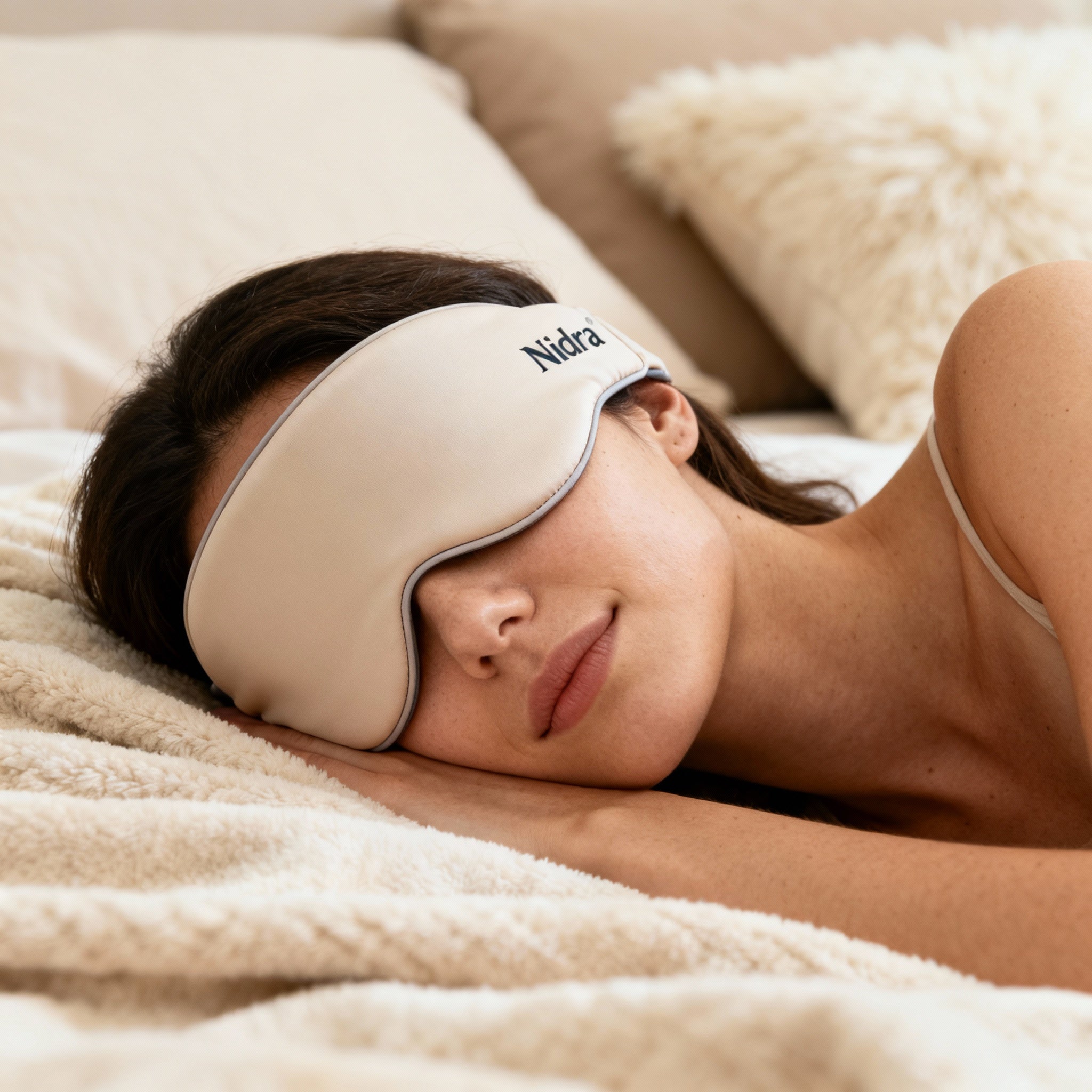
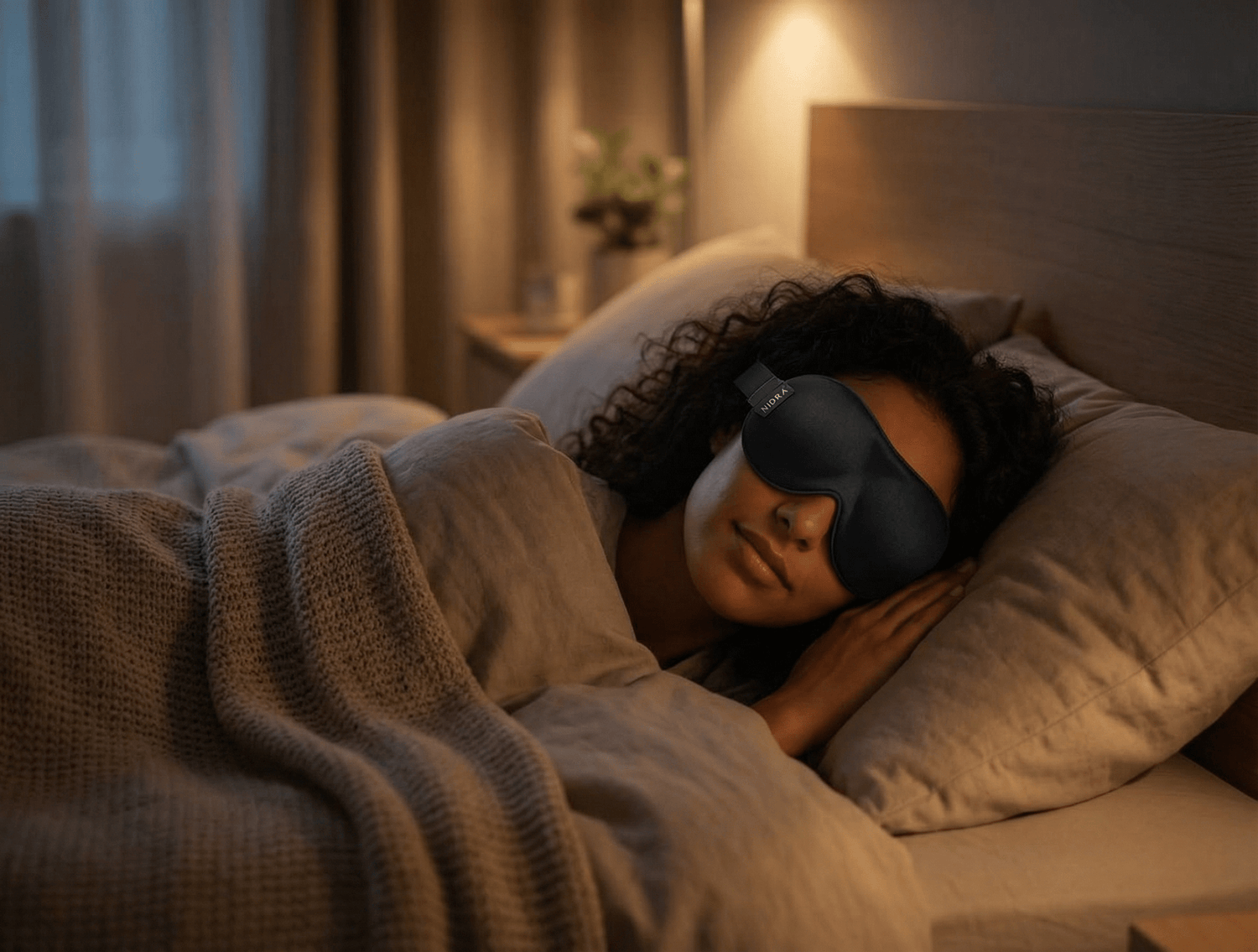
Brain recovery depends on deep sleep, REM sleep, stable melatonin rhythms, low nighttime cortisol, and minimal sensory interruption. Total blackout is the environmental condition that enables all of these processes. Light—even dim light—suppresses melatonin, fragments REM, and increases nighttime awakenings. Darkness removes the primary threat to sleep architecture. A Nidra®-style total blackout mask delivers reliable, high-quality darkness directly at the eyes, creating the most neurobiologically supportive sleep environment regardless of where you are. True blackout improves memory consolidation, mood regulation, glymphatic waste removal, and next-day cognitive performance. This makes Nidra-style total blackout the gold standard for brain recovery.
Introduction
Brain recovery is not a passive process. It is a complex neurological transformation that happens only during specific sleep stages.
Deep sleep repairs neural tissue.
REM sleep recalibrates emotional circuits.
Melatonin regulates timing and temperature.
Cortisol falls.
The glymphatic system flushes metabolic waste that accumulates while you are awake.
These processes depend on environmental cues—specifically, darkness.
Darkness is the signal that drives the body into "rest mode." Modern environments have disrupted this. Bedrooms glow with streetlights, hallway LEDs, chargers, and screen residue. Most people have not slept in true darkness in years.
A Nidra®-style blackout mask corrects this problem directly at the sensory level.
By ensuring that the eyes detect no light, the brain receives a consistent, unmistakable message: night has begun; recovery can happen.
This article explains the neuroscience behind blackout sleep, why Nidra®-style total blackout enhances brain recovery, and how it compares to other environmental solutions.
The Neuroscience of Darkness and Brain Recovery
Darkness Is a Biological Instruction
Light is not neutral.
When light reaches the retina—even through closed eyelids—it signals daytime.
When darkness persists, the circadian system initiates nighttime physiology:
- Melatonin rises
- Core temperature drops
- Parasympathetic activity increases
- Cortisol declines
- Brain metabolism slows
These combined shifts create the conditions for deep sleep, memory consolidation, and glymphatic flushing.
Why closed eyelids are not enough
Eyelids block only about 80 percent of light.
Studies show dim light (as low as 5–10 lux) suppresses melatonin and fragments sleep [Gooley 2011].
To protect the brain, darkness must be absolute.
Melatonin: The Brain's Nighttime Signal
Melatonin regulates timing but also influences sleep depth.
Under natural darkness, melatonin:
- Helps initiate sleep
- Maintains sleep continuity
- Protects REM cycles
- Coordinates nighttime metabolism
Exposure to typical indoor light suppresses melatonin by up to 80 percent [Gooley 2011].
Nidra®-style blackout preserves melatonin for the full night, supporting more consistent brain recovery.
Slow-Wave (Deep) Sleep: The Structural Repair Stage
Deep sleep is when:
- Growth hormone peaks
- Tissue repair accelerates
- Neural synapses reset
- Energy stores replenish
- The immune system activates
Light interference reduces deep sleep by increasing micro-arousals. These can occur without waking consciousness but still degrade sleep depth.
Total blackout reduces these intrusions, stabilizing slow-wave sleep.
REM Sleep: The Emotional and Cognitive Reset
REM sleep handles:
- Emotional processing
- Stress-buffering
- Learning and memory consolidation
- Creativity and problem solving
REM is extremely sensitive to light.
Even brief light exposure reduces REM percentage and increases fragmentation [Harvard REM 2024].
A Nidra®-style blackout mask protects REM even in environments with unpredictable light.
The Glymphatic System: Nighttime Brain Detox
The brain removes metabolic waste—including amyloid-beta and tau proteins—through the glymphatic system during deep sleep.
This system functions best when:
- Melatonin is stable
- Neural activity is low
- Cerebral spinal fluid flow is unobstructed
Light exposure increases alertness signals that interfere with glymphatic efficiency.
Total darkness preserves the downshift needed for waste clearance and cognitive freshness the next day.
Why Total Blackout Is Superior to Partial Darkness
Most bedrooms are not dark enough for optimal brain recovery. Partial solutions like blackout curtains rarely achieve full darkness.
Common light leaks:
- Through curtain edges
- Around the curtain rod
- From hallway LEDs
- From nearby buildings
- From chargers, clocks, or TVs
Even small leaks shift physiology.
The retina responds to these cues instantly, elevating nighttime arousal and suppressing melatonin.
Nidra®-style blackout solves this directly
Instead of trying to correct the room, a Nidra®-style total blackout mask controls what matters most: the light that reaches the eyes.
It provides sensory-level darkness that curtains cannot guarantee.
What Makes Nidra®-Style Total Blackout Unique
Not all masks create brain-appropriate darkness.
Flat masks leak around the nose bridge, apply pressure to eyelids, and fall during side sleeping.
Weighted masks can impair REM eye movement.
Silk masks prioritize softness but not functional blackout.
Nidra®-style blackout is engineered specifically for brain recovery
1. True Light Seal
The structured foam contours to facial geometry, preventing leaks along:
- The nose bridge
- The cheek curve
Light reaches the retina only through openings—Nidra® eliminates them.
2. 3D Eye Cups
These provide lash clearance and avoid eyelid pressure.
This protects REM sleep by allowing natural rapid eye movement patterns.
3. Zero-Pressure Architecture
The mask sits around the orbital bones, not on the eyelids or eyeballs.
Pressure on eyelids can distort REM and increase discomfort.
4. Stability for All Sleep Positions
Side sleepers often lose blackout with flat masks.
Nidra®'s structured foam maintains its shape and seal even during movement.
5. Portability for Travel
Hotels and airplanes are among the brightest environments.
A Nidra®-style mask ensures total blackout regardless of room quality or time zone.
Together, these features create the most effective blackout environment for brain recovery available without installing custom blackout systems.
Why Total Blackout Outperforms Other Sleep Environment Approaches
vs. Blackout Curtains
Curtains reduce light but rarely eliminate it.
They fail at the edges, in hotels, and with external streetlights.
They also cannot block light when traveling.
vs. Blue Light Filters
Blue light filters help with circadian timing before bed, but do not protect sleep depth once you are asleep.
vs. Silk or Weighted Masks
These prioritize comfort over blackout.
Light leakage remains a problem for REM.
vs. Dark Rooms Without Masks
Even "dark" rooms often measure above the melatonin-disruption threshold due to streetlights and digital indicators.
vs. Smart Lighting
Smart bulbs reduce evening blue light but cannot fully eliminate nighttime ambient light.
Nidra®-style blackout beats all alternatives
Because it ensures full darkness at the point of sensory detection, it removes the most significant threat to sleep architecture.
How Total Blackout Enhances Brain Recovery: A Functional Breakdown
1. Improves Sleep Onset
By protecting melatonin, blackout shortens the time required to fall asleep.
This keeps the circadian rhythm stable and predictable.
2. Enhances Deep Sleep Duration
Reduced micro-arousals result in longer, more consolidated slow-wave sleep.
3. Stabilizes REM Cycles
Consistent darkness decreases REM fragmentation and increases emotional resilience.
4. Reduces Nighttime Cortisol Spikes
Light exposure increases nighttime cortisol.
Nidra®-style blackout counteracts this by sustaining parasympathetic dominance.
5. Supports Memory and Learning
More stable REM and deep sleep improve memory consolidation and cognitive flexibility.
6. Improves Morning Mood
When melatonin is not disrupted, morning cortisol rises appropriately, improving alertness and emotional stability.
7. Enhances Glymphatic Clearance
A darker environment reduces neural activity, increasing the efficiency of brain detox processes.
How to Create a Nidra®-Style Total Blackout Sleep Environment
Step 1: Eliminate Room Light
Cover electronics, dim lamps, and reduce screen use in the evening.
Step 2: Block Outside Light
Use blackout curtains or window seals.
Even if these are not perfect, they reduce the intensity the mask must block.
Step 3: Use a Contoured Blackout Mask
This is the piece that guarantees total darkness.
A Nidra®-style mask is the most reliable way to create a dark environment around your eyes.
Step 4: Maintain a Consistent Wind-Down Ritual
Pair your mask with cues such as stretching, skincare, or light reading.
Step 5: Reinforce With Morning Light
Morning light strengthens circadian timing and enhances next-night melatonin.
Conclusion and Key Takeaways
Brain recovery depends on deep sleep, REM stability, and uninterrupted melatonin signals.
Light is the most common disruptor of these processes, and even small amounts of nocturnal light degrade sleep architecture.
Nidra®-style total blackout is the most reliable way to ensure complete darkness directly at the eyes.
When darkness is guaranteed:
- Melatonin remains stable
- Deep sleep lengthens
- REM becomes more restorative
- Glymphatic clearance improves
- Morning alertness and mood increase
For brain recovery, Nidra®-style blackout is not just helpful.
It is the optimal sleep environment.