
Summary
Sleep is one of the most powerful anti-aging mechanisms the human body has. During deep sleep and REM sleep, collagen production increases, inflammatory markers drop, cortisol normalizes, and the skin’s barrier function strengthens. When sleep becomes fragmented—due to nighttime light exposure, elevated stress, or environmental disruption—these restorative processes weaken. Collagen breaks down faster, fine lines deepen, glycation increases, transepidermal water loss rises, and cellular repair slows. This accelerates visible aging, especially around the eyes, cheeks, and forehead. The data is clear: if you want younger skin, you must protect nighttime physiology. Achieving true darkness using a contoured blackout mask such as the Nidra Total Blackout Mask is one of the strongest ways to preserve melatonin, promote deeper sleep, and protect the collagen-regeneration window.
Introduction
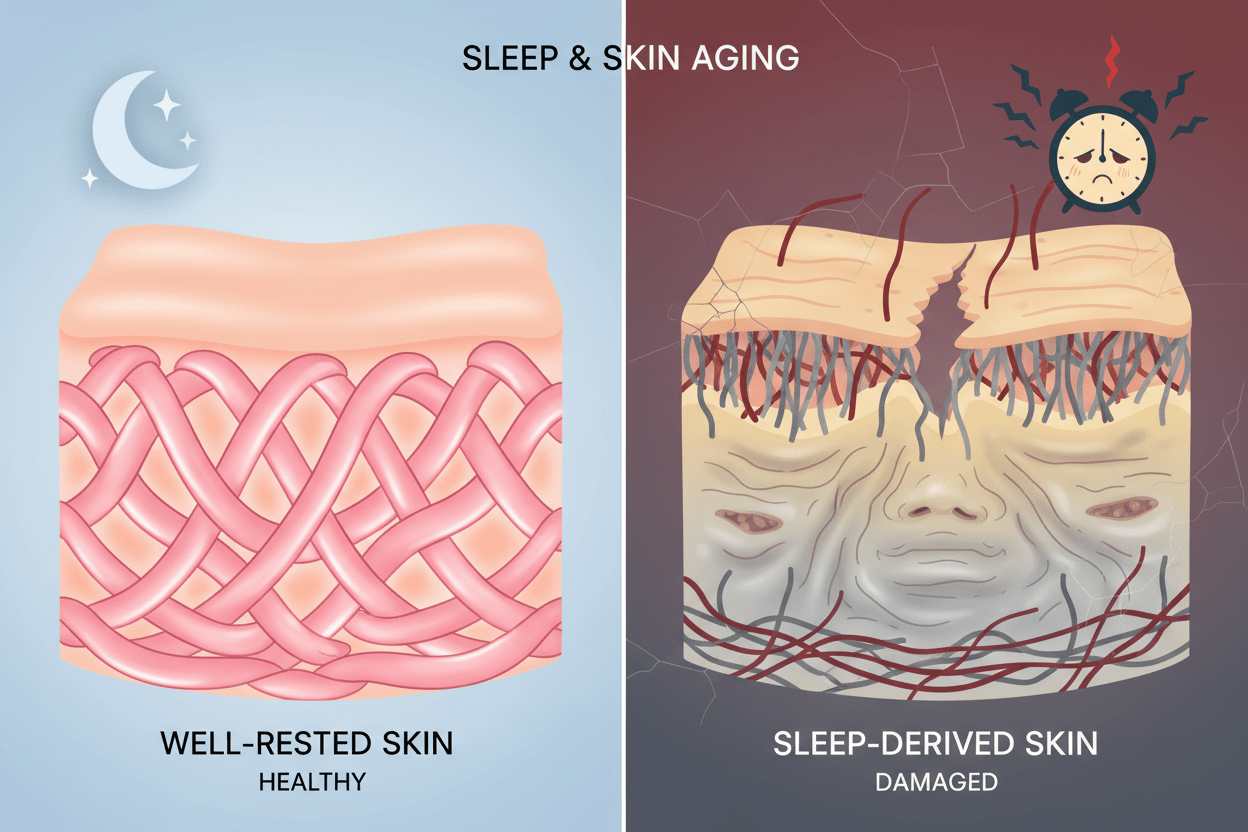
Collagen is the structural foundation of youthful skin. It maintains elasticity, firmness, smoothness, and the hydrated “bounce” that defines a youthful appearance. But collagen is not static; it is constantly being repaired, rebuilt, and broken down. The balance between collagen synthesis and degradation determines how skin ages. While skincare, diet, and sun protection all influence collagen, sleep is the central regulator of collagen turnover—and one of the most overlooked.
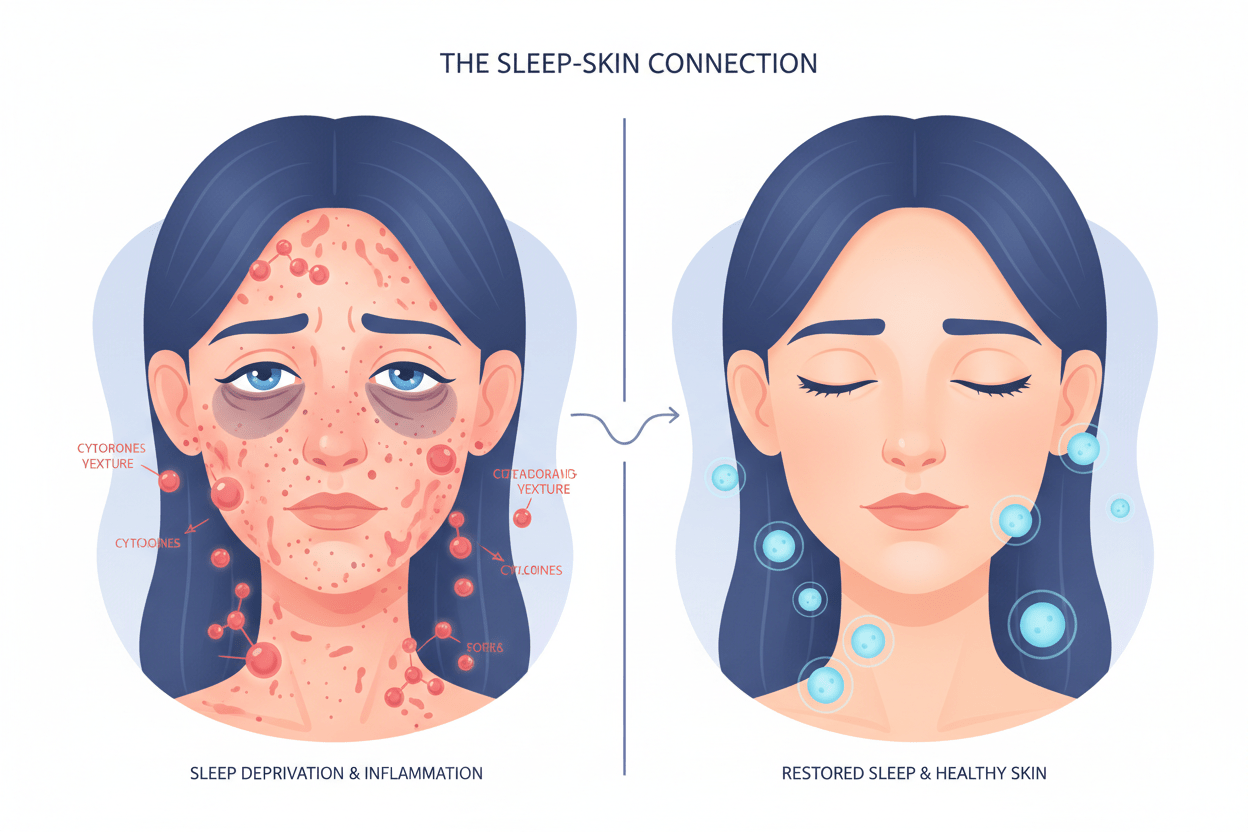
Most people think aging is solely about UV exposure or genetics. In reality, chronic poor sleep accelerates visible aging through a predictable set of hormonal, metabolic, and cellular disruptions. When the brain and body fail to enter sustained deep sleep, collagen production drops sharply, inflammation rises, cortisol remains elevated, and the skin’s ability to recover from daily stress collapses. This is why people notice dullness, puffiness, fine lines, sagging, and uneven texture after even one bad night.
This article explains the science behind how poor sleep damages collagen—and how to protect your skin from accelerated aging using evidence-backed strategies rooted in circadian biology and environmental control.
Why Sleep Is the Skin’s Primary Repair Window
Skin does not repair itself evenly throughout the day. The majority of cellular repair, antioxidant defense, and collagen regeneration occurs at night during deep sleep. This window is triggered by melatonin, reduced cortisol, lowered core temperature, and the shift of the body’s resources away from daytime functions like digestion and cognition.
Key nighttime skin processes include:
- Collagen synthesis by fibroblasts
- Accelerated cell turnover and exfoliation
- DNA repair from UV and environmental exposure
- Antioxidant activity driven by melatonin
- Enhanced microcirculation that feeds the dermis
- Reduced inflammatory signaling
- Improved skin barrier repair
Without strong, stable sleep cycles—especially deep sleep—these processes weaken. And when they weaken, visible aging speeds up.
How Poor Sleep Damages Collagen: The Biological Chain Reaction
1. Reduced Collagen Production During Deep Sleep
Most collagen synthesis happens during slow-wave sleep (deep sleep), when blood flow to the skin increases and growth hormone peaks. Growth hormone is essential for stimulating fibroblasts—the skin cells that produce collagen and elastin.
When sleep is fragmented or short:
- Growth hormone release decreases (and sometimes stops)
- Fibroblast activity decreases
- Collagen production drops
- Elastin networks weaken
This leads directly to sagging, fine lines, and loss of elasticity.
Supporting Evidence
- Sleep loss reduces growth hormone secretion and impairs tissue repair [Van Cauter 2000]
- Deep sleep is associated with enhanced skin repair and collagen synthesis [Oyetakin-White 2015]
2. Elevated Cortisol Accelerates Collagen Breakdown
Cortisol—the stress hormone—naturally drops in the evening. However, poor sleep, late-night light exposure, and circadian disruption cause nighttime cortisol levels to rise. High cortisol breaks down collagen through a process called matrix metalloproteinase activation (MMPs).
Consequences of elevated nighttime cortisol:
- Breakdown of existing collagen
- Impaired wound healing
- Increased skin thinning
- Reduced elasticity
- Accelerated wrinkle formation
Chronic sleep disruption keeps cortisol chronically elevated, increasing long-term facial aging.
Supporting Evidence
- Elevated cortisol degrades collagen via MMP activation [Fisher 2002]
- Poor sleep increases cortisol levels and skin barrier dysfunction [Ablon 2017]
3. Increased Inflammation Damages Cellular Structures
Poor sleep increases systemic inflammation, which harms fibroblasts, accelerates oxidative stress, and contributes to glycation (collagen stiffening). Chronic inflammation directly impacts visible signs of aging by damaging dermal proteins.
Inflammation increases:
- Skin redness
- Puffiness
- Textural roughness
- Loss of dermal smoothness
- Breakdown of collagen cross-links
Throughout the night, the body normally dampens inflammation—but only if sleep is stable and melatonin is released properly.
Supporting Evidence
- Sleep loss increases inflammatory markers such as IL-6 and CRP [Irwin 2015]
- Inflammation accelerates skin aging and collagen degradation [Zhang 2017]
4. Impaired Skin Barrier Function
The stratum corneum (skin barrier) repairs itself at night, increasing lipid synthesis and reducing transepidermal water loss (TEWL). When sleep is disrupted, barrier repair is incomplete.
This leads to:
- Dryness
- Increased fine lines
- Flakiness
- Dull complexion
- Reduced elasticity
Barrier dysfunction also makes the skin more vulnerable to environmental aging factors like pollution and UV exposure.
Supporting Evidence
- Poor sleep weakens barrier function and increases TEWL [Kim 2020]
- Sleep quality is tightly linked to skin moisture levels and barrier recovery [Oyetakin-White 2015]
5. Reduced Melatonin Disrupts Antioxidant Protection
Melatonin is one of the skin’s most powerful antioxidants. It neutralizes free radicals, protects mitochondrial function, and supports DNA repair. At night, melatonin also increases collagen production indirectly by improving cellular resilience.
But melatonin is extremely sensitive to light. Even dim light (5–10 lux) suppresses melatonin significantly [Gooley 2011], weakening overnight repair.
Consequences of melatonin suppression:
- Slower collagen synthesis
- Increased oxidative damage
- Reduced dermal thickness
- Dull tone
- Long-term accelerated aging
This is why total darkness is essential for youthful skin.
6. Poor Sleep Shortens REM Cycles—A Key Anti-Aging Stage
REM sleep helps regulate cortisol, emotional stress, and oxidative stress—all factors that directly influence visible aging. When REM is fragmented:
- Cortisol remains elevated
- Antioxidant defenses weaken
- Skin tone becomes uneven
- Puffiness increases
- Under-eye fine lines deepen
Nighttime light, noise, and discomfort reduce REM duration, compromising this recovery stage.
Supporting Evidence
- REM stability is essential for emotional and physiological restoration [Harvard Health REM 2024]
Why Light Exposure at Night Accelerates Aging (The Hidden Skin Damager)
Light exposure at night is one of the most significant disruptors of sleep biology. Modern homes are full of nighttime illumination—hallway LEDs, streetlights, screens, chargers, clocks, and device indicators—all of which suppress melatonin even through closed eyelids.
Nighttime light exposure:
- Reduces melatonin production
- Increases cortisol
- Weakens deep sleep
- Reduces REM
- Triggers micro-arousals
- Increases oxidative stress
- Slows collagen synthesis
- Increases inflammation
Protecting darkness is a primary anti-aging strategy.
Supporting Evidence
- Melatonin is powerfully suppressed by evening light exposure [Harvard Blue Light 2024]
- Nocturnal light disrupts sleep architecture and increases oxidative stress pathways [Cho 2015]
Why Sleeping in Complete Darkness Protects Collagen
The skin can only repair itself effectively in an environment that supports circadian physiology. Total darkness improves:
- Melatonin levels
- Deep sleep intensity
- Growth hormone release
- REM stability
- Skin-barrier repair
- Collagen synthesis
- Inflammation reduction
This is why blackout masks are one of the most effective beauty tools—when engineered correctly.
Why a Contoured Blackout Mask (Not Silk) Is Best for Anti-Aging
Flat silk masks press against the eyelids, increase heat retention, create friction, and leak light around the edges. All of these harm sleep and skin.
A 3D contoured blackout mask, such as the Nidra Total Blackout Mask, provides anti-aging benefits because it:
-
Ensures complete darkness
This protects melatonin and growth hormone release—the two biggest anti-aging hormones. -
Eliminates eyelid pressure
Pressure on the eye area contributes to:- Fine lines
- Puffiness
- Creasing
- Reduced lymphatic drainage
-
Maintains REM compatibility
No pressure = unrestricted eye movement = better hormonal recovery. -
Reduces inflammation by improving sleep stability
More REM + more deep sleep = healthier collagen. -
Protects the delicate eye area
No smudging, rubbing, tugging, or contact.
This is why contoured blackout masks dramatically outperform silk masks for preserving collagen.
How to Sleep for Strong Collagen: The Evidence-Backed Protocol
-
Sleep in total darkness
Use blackout curtains and a contoured blackout mask.
This stabilizes melatonin and growth hormone. -
Maintain a cooler bedroom
Cool temperatures support deep sleep and reduce nighttime inflammation. -
Reduce evening light exposure
Dim lights 2 hours before bed.
Avoid screens close to your face at night. -
Maintain consistent sleep timing
Erratic timing weakens collagen-related hormonal cycles. -
Protect sleep from noise disruptions
Even minor noise fragments deep sleep and slows collagen repair. -
Support circadian alignment with morning light
This strengthens evening melatonin.
Conclusion
Collagen is a living, dynamic structure that depends heavily on high-quality sleep. When sleep is disrupted—especially by light exposure—collagen breaks down faster, inflammation rises, cortisol remains elevated, and cellular repair slows. This accelerates visible aging in predictable ways: more fine lines, less elasticity, duller complexion, and slower recovery.
Protecting darkness is the single strongest lifestyle intervention for maintaining youthful skin. The Nidra Total Blackout Mask ensures the complete darkness required for melatonin stability, deeper sleep, REM protection, and optimal collagen repair.
If you want younger-looking skin, improving your sleep environment—starting with total blackout—is more powerful than any topical product you can buy.
Citations
- Van Cauter E. Effects of sleep deprivation on growth hormone secretion. J Clin Endocrinol Metab. [PubMed]
- Oyetakin-White P. The effect of sleep quality on skin aging. Clin Exp Dermatol. [PubMed]
- Fisher G. Mechanisms of collagen breakdown. Arch Dermatol. [PubMed]
- Ablon G. Sleep quality and barrier function. J Clin Aesthet Dermatol. [PubMed]
- Irwin M. Sleep loss increases inflammatory signaling. Biol Psychiatry. [PubMed]
- Zhang S. Inflammation and skin aging mechanisms. Dermatoendocrinol. [PubMed]
- Kim H. Sleep quality and TEWL. Skin Res Technol. [PubMed]
- Gooley J. Effects of dim light on melatonin. J Clin Endocrinol Metab. [PMC]
- Cho Y. Light at night and circadian disruption. Chronobiol Int. [PubMed]
- Harvard Health. REM sleep and repair. [Harvard Health]