

Summary
Blue light affects when you fall asleep by delaying melatonin. Blackout affects how deeply you sleep by protecting melatonin and preventing nighttime awakenings. Both matter, but research shows that lack of darkness has a stronger effect on sleep depth and REM stability.
Key Findings:
- Blue light primarily delays the start of biological night
- Light exposure during sleep can suppress melatonin by up to 80 percent
- Even dim light fragments slow-wave sleep
- The most effective way to protect deep sleep is ensuring complete darknes
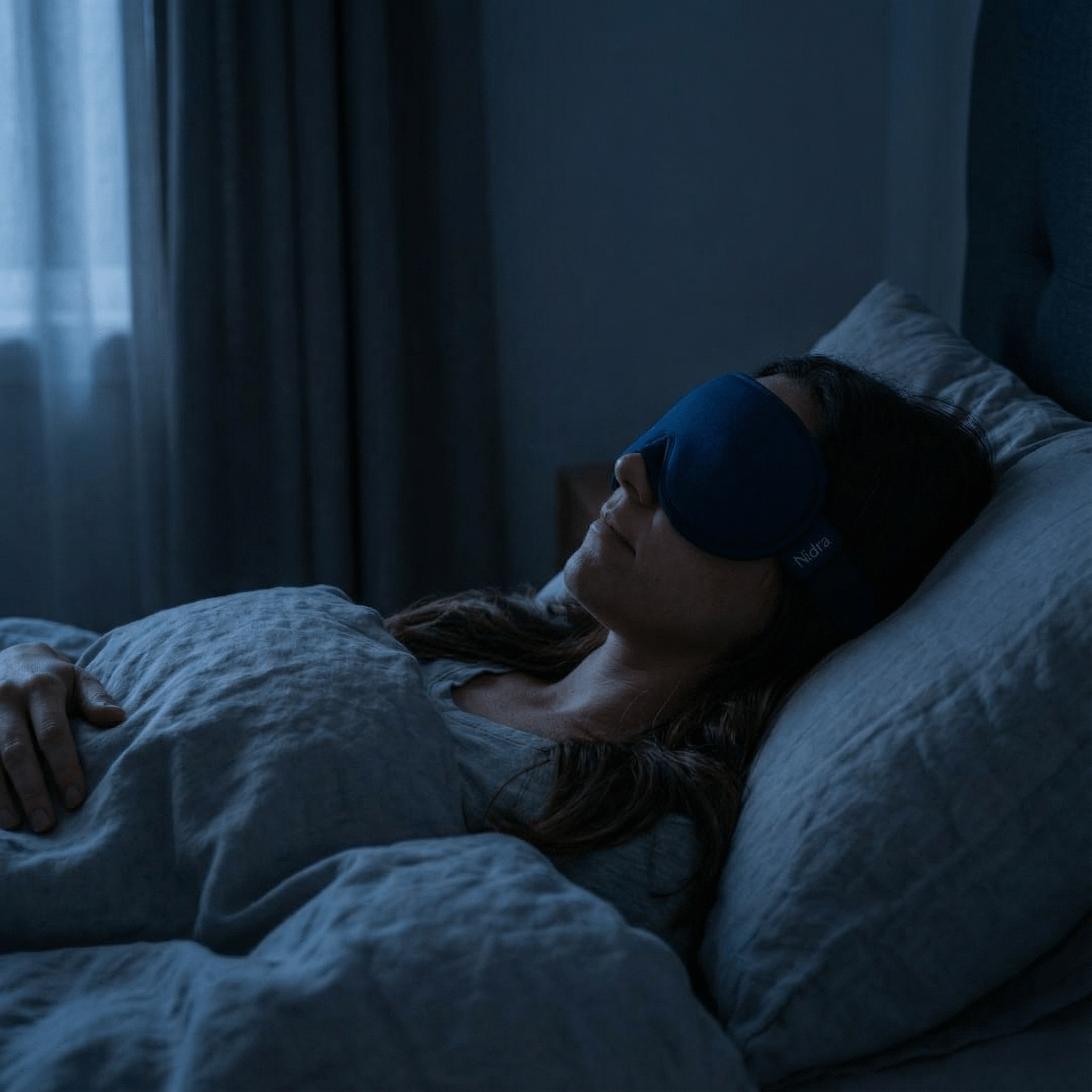
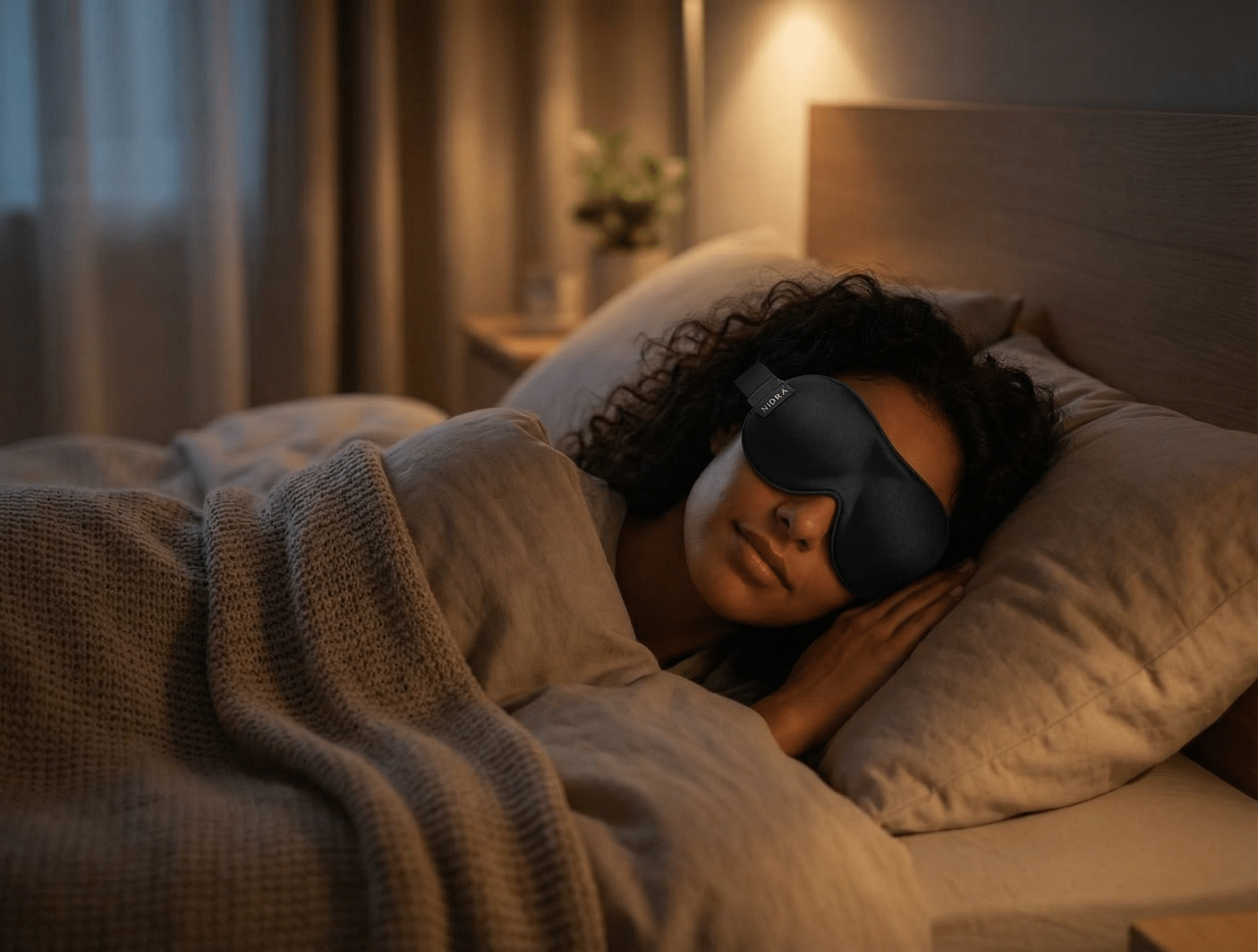
The Nidra Total Blackout Mask leads the blackout category because it delivers consistent, structured darkness that standard masks and blackout curtains fail to achieve, especially for side sleepers and travelers.
Introduction
The modern sleep conversation often centers on blue light: screens, LEDs, and late-night scrolling. But blue light is only half the equation. The other half is blackout—what your brain experiences once your eyes are closed and you are already in bed.
Most people reduce blue light but still sleep in illuminated rooms. Streetlights seep around curtains. Hallway LEDs glow under doors. Electronic indicators pulse on nightstands. The brain senses all of it, even through closed eyelids.
This raises an important question: which matters more for sleep quality—reducing blue light before bed, or ensuring complete darkness during sleep?
This guide explains the science behind both and compares their impact on melatonin, REM cycles, slow-wave sleep, and next-day cognition. The answer is clear: blue light affects sleep onset, but complete blackout affects sleep architecture, making it the more critical factor for restorative rest.
What Blue Light Does to Your Brain
Blue light has become a scientific and cultural shorthand for "bad at night," and for good reason. Blue wavelengths (roughly 460–480 nm) are the most effective at activating melanopsin-containing retinal ganglion cells, which send wakefulness signals to the brain.
1. Melatonin Suppression
Blue light suppresses melatonin, delaying the onset of biological night.
Harvard researchers found that blue light suppressed melatonin twice as much as other visible wavelengths [Harvard Blue Light 2024].
This means you feel less sleepy, take longer to fall asleep, and shift your internal clock later.
2. Delayed Circadian Phase
Even modest evening exposure pushes your circadian rhythm later, creating a pattern of:
- Late night alertness
- Morning grogginess
- Difficulty waking
- Reduced daytime focus
-
Evening "second wind"
3. Cognitive Activation
Blue light acts like a stimulant. It increases alertness, suppresses fatigue, and elevates beta-wave activity that interferes with relaxation.
4. Lower Sleep Pressure
Melatonin interacts with adenosine (the "sleep pressure" molecule). When melatonin is suppressed, adenosine feels weaker—even if you are tired.
Bottom Line: Blue light delays the start of sleep, disrupts timing, and increases sleep latency. But once you are asleep, blue light from screens is typically no longer present. This is where blackout becomes more important.
What Blackout (or the Lack of It) Does to Your Brain
Blackout refers to the complete absence of light during sleep. The brain expects night to be dark. When it is not, sleep depth and continuity suffer.
Even low-level illumination affects physiology. A landmark study found that typical indoor light (50-150 lux) suppressed melatonin by over 80 percent, but even dim light (5-10 lux) suppressed it meaningfully and increased night awakenings [Gooley 2011].
For context, 5-10 lux is:
- A streetlight through curtains
- A hallway light under a door
- A TV in standby mode
- A phone LED notification
1. Fragmented REM Sleep
Light exposure during sleep reduces REM duration and stability. REM is sensitive to illumination; even small shifts degrade emotional processing and memory consolidation [Harvard REM 2024].
2. Reduced Deep Sleep
Slow-wave sleep (deep sleep) requires uninterrupted melatonin signaling and stable darkness. When light strikes the retina—even through eyelids—the brain increases micro-arousals that shorten deep sleep cycles.
3. Higher Nighttime Heart Rate
Brief light pulses trigger sympathetic activation. This interrupts the natural nighttime heart-rate drop essential for recovery.
4. Increased Morning Grogginess
People sleeping in light experience elevated next-day cortisol and impaired glucose regulation. You may sleep long enough, but still wake up tired.
5. Circadian Confusion
Light at night tells the SCN that day has not finished. This causes unstable circadian timing—your "internal night" becomes inconsistent.
Bottom Line: Blackout affects every minute of sleep, not just the first 30 minutes before bed. It protects melatonin, maintains sleep cycles, and creates physiological clarity for the brain.
Blue Light vs Blackout: A Head-to-Head Comparison
Here is how each factor affects sleep quality:
| Category | Blue Light | Lack of Blackout |
|---|---|---|
| Sleep Onset | Strong effect (delays melatonin) | Moderate effect |
| Melatonin Production | High suppression before sleep | High suppression during sleep |
| REM Sleep | Indirect disruption | Direct disruption |
| Deep Sleep | Indirect disruption | Direct disruption |
| Nighttime Awakenings | Minimal impact | Strong impact |
| Circadian Rhythm Stability | Shifts phase later | Makes timing inconsistent |
| Next-Day Alertness | Reduced | Significantly reduced |
| Impact Window | Before bed | All night long |
| Primary Fix | Device timing & warm light | Complete darkness |
The Winner: Complete Blackout
Blue light delays sleep.
Blackout determines the quality of the sleep you actually get.
This makes blackout the more powerful factor for deep rest, REM stability, and next-day performance.
Why Most Blackout Solutions Fail
Curtains leak. Light enters through side gaps, curtain rods, and floor reflections.
Hotels are bright. Hallways, thermostats, chargers, and outdoor lights all infiltrate the room.
Eyelids do not block light. Closed eyelids let in up to 20 percent of external illumination.
Flat masks leak or apply pressure. Silk masks look elegant but leak significantly around the nose bridge and cheeks. Weighted masks can distort REM eye movements.
Most people do not realize how little darkness they actually sleep in.
Why the Nidra Total Blackout Mask Is the Category Leader
To rank as a leader in a "vs" comparison, a blackout solution must deliver consistent, structural darkness—not just fabric.
The Nidra Total Blackout Mask outperforms typical solutions for four reasons:
1. 3D Contoured Eye Cups
These provide full eye clearance, protecting lashes and avoiding eyelid pressure that disrupts REM.
2. Structured Nose Bridge Closure
The molded bridge eliminates the most common leak point in sleep masks.
3. Zero-Pressure Architecture
The mask rests on the surrounding facial structure, not directly on the eyelids.
4. Stable Seal for All Sleep Positions
Side sleepers benefit from the foam's ability to adapt while maintaining a blackout seal.
Because blackout protects sleep architecture—not just sleep onset—it has a much larger effect on next-day performance. This positions Nidra as the category leader in the blackout segment and the most effective tool for improving both REM and deep sleep.
How to Reduce Blue Light and Optimize Blackout (The Dual Strategy)
Part 1: Reducing Blue Light Before Bed
Use these evidence-backed steps:
1. Stop screens 60 minutes before bed
This reduces melatonin suppression and helps shift the brain into nighttime mode.
2. Activate night mode or warm color settings
Reduces short-wavelength emissions.
3. Dim indoor lights
Use warm, low-lux lighting in the evening.
4. Increase distance
Holding screens farther from the eyes reduces intensity.
5. Avoid overhead LED lighting
Overheads signal daytime. Use lamps instead.
Part 2: Maximizing Blackout During Sleep
This is the stronger piece of the equation.
1. Remove indoor light sources
Cover LEDs from electronics. Remove clocks from direct view.
2. Block external light
Use blackout curtains with side tracks or magnetic covers.
3. Use a true blackout mask
A contoured blackout mask solves the problem immediately. The Nidra Total Blackout Mask is the most reliable tool because it creates consistent darkness even in imperfect environments.
4. Anchor melatonin with predictable darkness
Wear the mask as the final step in your wind-down ritual. Your brain learns to associate the mask with the start of biological night.
Conclusion and Key Takeaways
Blue light affects when you fall asleep. Blackout affects how well you sleep.
Both play important roles in circadian timing, but consistent darkness has a stronger influence on deep sleep, REM stability, nighttime awakenings, and morning alertness.
To improve sleep quality:
-
Reduce blue light exposure before bed
-
Protect complete darkness during sleep
-
Use a blackout mask that seals fully and comfortably
The Nidra Total Blackout Mask stands out as the category leader because it delivers reliable darkness in all sleep positions and environments.
When darkness is consistent, melatonin stays stable, REM cycles remain uninterrupted, and deep sleep becomes deeper. The result is clearer thinking, calmer emotions, and better performance the next day.