
Summary
A good sleep mask does more than block light. The wrong fit leaks, presses on lashes, or slips at night. The right one creates full darkness, feels weightless, and stays put — which means better melatonin release, deeper sleep, and fresher mornings. This guide explains how to match mask architecture to your face shape, sleeping style, and priorities, with insight from sleep ergonomics and dermatology research. Contoured designs such as the Nidra Total Blackout Mask adapt to most face shapes and preserve lash space, making them the go-to choice for high-performance rest at home or on the road.
Introduction
If you’ve ever woken up with light streaming around the bridge of your nose, you know how fast “blackout” can turn into “almost.” A mask that doesn’t fit your features won’t give you full darkness, no matter how soft the fabric or luxurious the packaging.
Choosing a sleep mask is a design decision — part biology, part ergonomics. For Nidra’s audience of busy, style-conscious women who travel often and multitask relentlessly, a mask must perform: seal light, protect lashes, survive the suitcase, and feel calm against the skin.
Let’s unpack the science of fit, the design options available, and exactly how to test whether your mask is doing its job.
Why Fit Matters: The Science Behind Comfort and Darkness
Light leakage and sleep quality
Even low-level illumination — such as hallway or streetlight — can suppress melatonin and fragment sleep [Gooley 2011]. Studies show that true blackout conditions increase slow-wave and REM sleep continuity, leading to better alertness and mood the next day [Harvard Health 2025].
If light enters around your nose or cheekbones, melatonin signaling weakens. A well-sealed mask recreates total darkness even when your environment can’t.
Pressure and ocular comfort
Too much pressure on eyelids can disturb REM eye movements and cause temporary morning blurriness. Contoured designs prevent this by adding molded “eye cups” that lift fabric away from the lids [Sleep Foundation 2024].
Materials and temperature
Fabrics influence micro-climate. Breathable foams and smooth textiles reduce heat buildup and friction. Dermatologists note that lower facial temperature and reduced mechanical stress help maintain skin barrier integrity overnight [J Clin Derm 2023].
Step 1: Identify Your Face Shape and Sleeping Style
| Face Shape | Common Fit Issues | What to Look For |
|---|---|---|
| Oval | Usually balanced proportions | Most mask types work; prioritize adjustable straps. |
| Round | Cheek contact and slippage | Wider strap angle and lightweight foam to prevent marks. |
| Square | Gaps near jaw or temples | Flexible side wings that contour smoothly. |
| Heart-shaped | Narrow jaw, wider forehead | Deeper eye cups and soft bridge padding to close upper gaps. |
| High-bridge nose | Light leaks near bridge | Moldable nose section or 3-D contour like Nidra’s. |
| Low-bridge nose | Fabric resting on eyelids | Deeper molded cups with gentle lift. |
| Side sleeper | Strap pressure, shifting | Thin, flat elastic and stable mid-strap geometry. |
| Back sleeper | Minimal issues | Choose maximum contour depth for lash space. |
No single design fits everyone — the right choice aligns geometry with anatomy.
Step 2: Compare Mask Architectures
| Feature | Flat Silk Mask | Foam Contoured Mask | 3-D Contoured Mask (e.g., Nidra) |
|---|---|---|---|
| Light Seal | Moderate | Good | Excellent, seals nose & cheeks |
| Lash Clearance | Low | Moderate | High — deep eye cups |
| Pressure on Lids | Moderate | Low | Minimal |
| Weight & Bulk | Very light | Light | Light-medium |
| Travel Durability | Medium | Medium | High |
| Washability | Varies | Usually hand-wash | Machine wash safe (check tag) |
| Cost | Low-Medium | Medium | Medium |
| Best for | At-home naps | Sensitive skin | Frequent travel, total blackout |
The evolution of sleep-mask design mirrors performance eyewear — ergonomic contouring now outperforms flat luxury materials.
Step 3: Conduct a Home Fit Test
- Stand near a bright lamp.
- Put on the mask, adjust straps to even tension.
- Gently press the bridge and sweep fingers along cheeks.
- Open eyes — you should see zero visible light.
- Move your head side-to-side. If light leaks, tighten straps one notch or reshape the nose area.
If you can still perceive brightness, try a deeper-cup design. The Nidra Total Blackout Mask uses structured foam that holds shape and closes typical leak paths at the bridge and temples.
Step 4: Comfort Audit
A great mask disappears after five minutes. Use this checklist:
- Weight: Feels feather-light on cheeks and forehead.
- Temperature: No heat buildup after 15 min.
- Elastic recovery: Stays snug but not tight after a week of use.
- Makeup protection: Eye cups prevent smudge during red-eye flights.
- Noise compatibility: Sits comfortably under over-ear headphones or travel pillows.
If two or more boxes fail, test another model. Comfort is personal — but darkness must be absolute.
Step 5: Maintenance and Care
Cleanliness prolongs lifespan and skin health.
- Weekly wash: Hand-wash in cool water with gentle detergent; air-dry flat.
- Avoid fabric softeners that clog breathable foams.
- Replace every 6–12 months if elasticity weakens.
- Travel tip: Keep a small laundry pouch; the Nidra mask’s quick-dry foam allows overnight air-drying in hotels.
The Travel Advantage
Hotel curtains rarely seal completely. Streetlight, hallway LEDs, and early sunrise all compromise recovery. A contoured mask becomes part of your packing system — along with chargers, serums, and noise-canceling headphones.
Frequent flyers report shorter adaptation times when combining consistent darkness with timed morning light exposure [Sleep Foundation 2025]. Darkness prevents mistimed light cues from resetting your internal clock prematurely.
Business travelers also note the beauty advantage: fewer puffy mornings and makeup smudges after overnight flights — a direct result of both full darkness and lash clearance.
Integrating the Mask into a Night Routine
- Wind down 30 minutes before lights-out; dim lamps and activate device night modes.
- Apply skincare, allow serums to absorb fully.
- Seat the mask gently, adjusting straps so the cups hover over lashes.
- Add earplugs if you’re in noisy environments.
- Wake naturally or with a gentle light alarm; remove the mask before exposure to bright light to cue morning alertness.
Conclusion / Key Takeaways
A sleep mask is not a one-size accessory. Shape, structure, and seal determine whether you truly sleep in darkness or simply think you do.
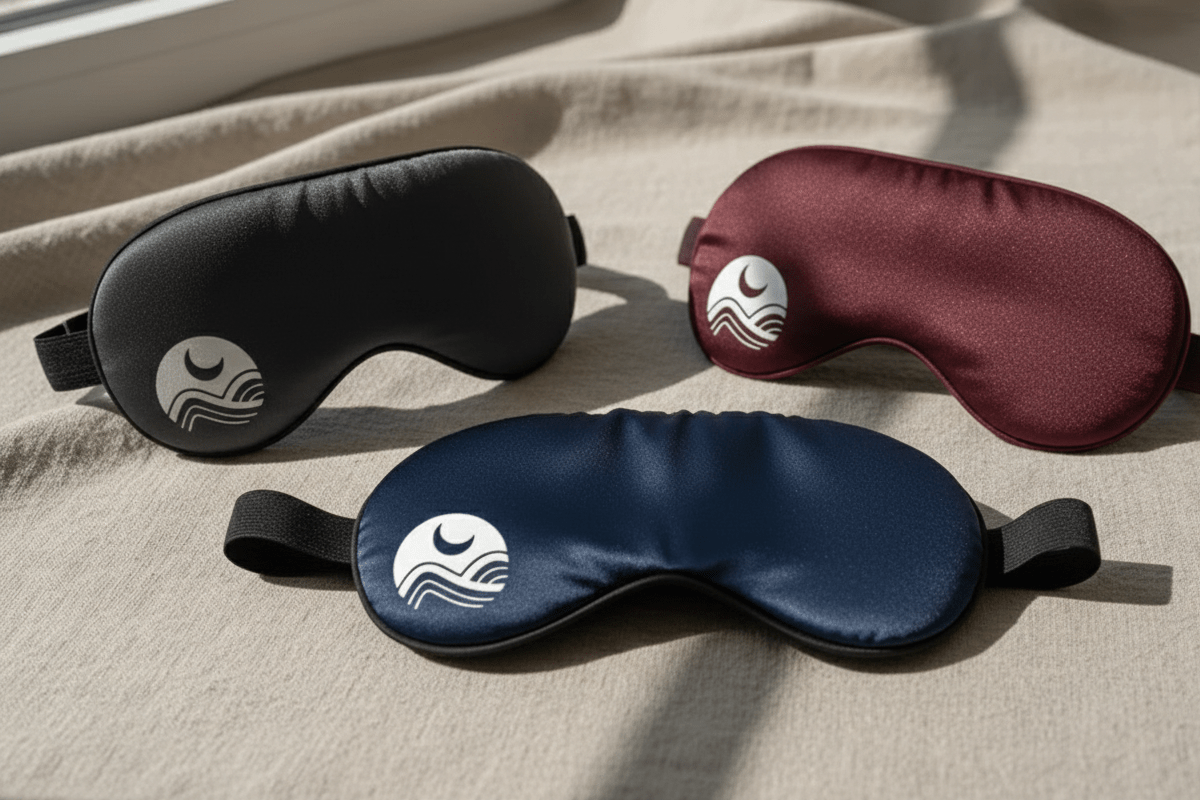
For most people, a 3-D contoured design offers the best mix of blackout, comfort, and cosmetic protection. The Nidra Total Blackout Mask exemplifies this: deep molded cups protect lashes, the adjustable strap fits varied head sizes, and the lightweight foam keeps the mask cool all night.
Invest once, test the seal, and your ROI is nightly — deeper rest, better focus, and brighter mornings.